Blog · Part 3 of 5
How Account-Based TV Finds Your Target Accounts
How account-based CTV actually works, step by step: from a name on your list to an ad on a connected TV, including where the match leaks.
Danny Stedman · · 11 min read
Short answer: Account-based CTV finds your target accounts on TV by starting with your list of companies, finding the people at those companies, and matching those people to the homes where they watch streaming TV. The ad then plays in those homes, and the reach is rolled back up into a report of which accounts on your list were reached. The key number to ask for is the account match rate: the share of your accounts with at least one person matched to a reachable home.
Key takeaways
- Account-based CTV starts from your own target account list, not from an audience segment a vendor built.
- The match runs through people: contacts at each company are turned into private hashed IDs and matched to households with connected TVs.
- Ask for the account match rate on your own list, because it varies by industry, company size and the roles you target.
- A 2026 study by Adstra and InterMedia Advertising found that only 23% of residential IP addresses reached their intended geographic target, a weak base for B2B TV targeting.
- Apple's iOS 27 privacy changes are aimed at web browsers and mostly don't affect TV apps, but they make website-pixel measurement weaker and favor data you already own, like your CRM.
Ask a CTV vendor how they find your accounts on TV, and the answer is usually a number, like "We reach 120 million households." That's how big the ocean is. It doesn't tell you whether your 400 accounts are swimming in it. So here's the real answer, leaks included.
What is account-based CTV?
Account-based CTV is TV advertising aimed at a specific list of companies instead of a broad audience. CTV stands for connected TV: any TV that streams over the internet, through a smart TV, a streaming stick or a game console, where ads can be targeted like digital ads. "Account-based" means the campaign is built around your named target accounts, the same list your sales team works, and success is measured by which of those accounts were reached.
How does account-based CTV targeting work?
Account-based CTV targeting works in five steps: clean up your list of companies, find the people at those companies, turn those people into private IDs and match them to homes, run the ad in those homes, and report back by account.
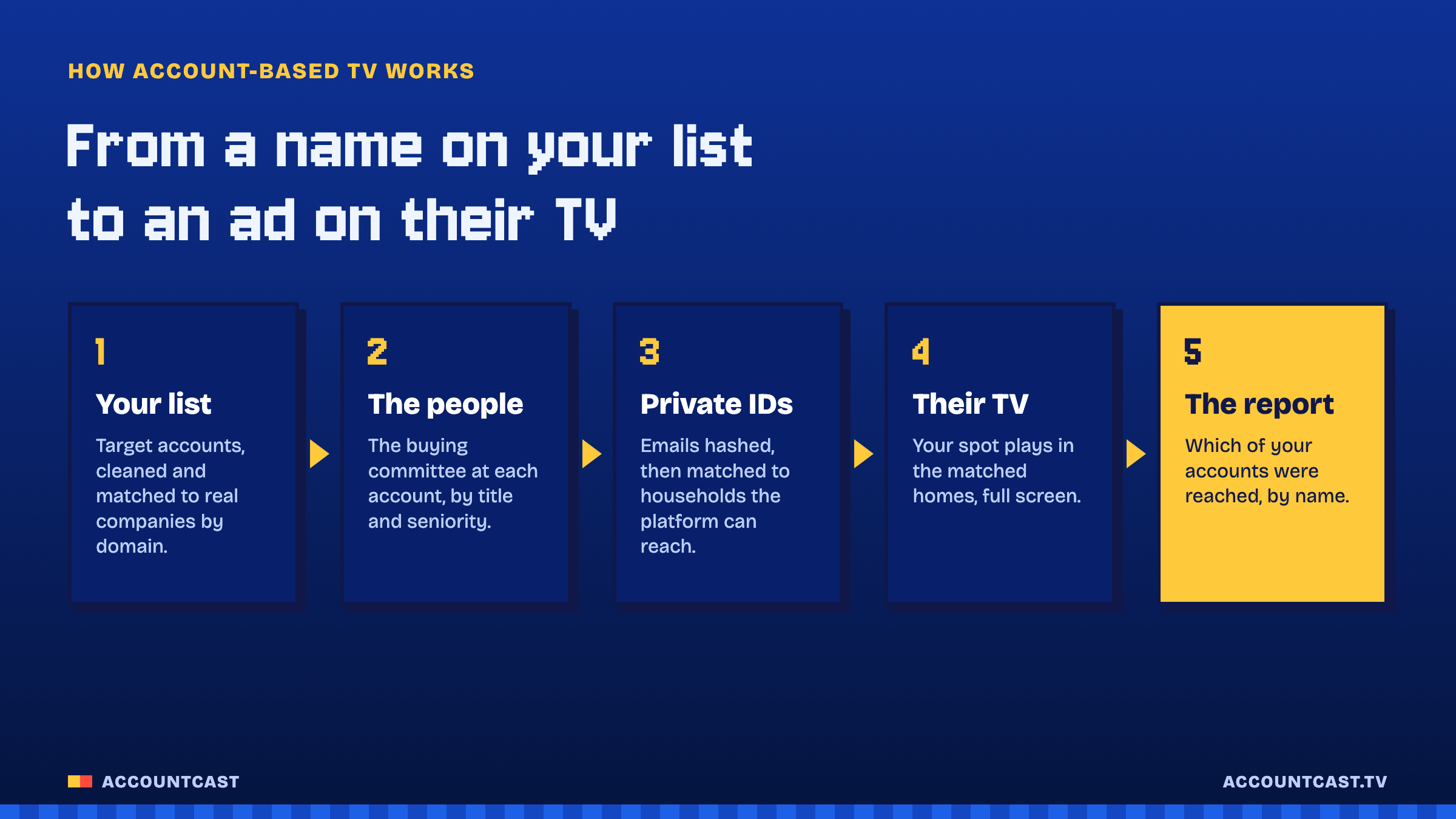
Start with the companies on your list. Your target account list gets cleaned up and each row is matched to a real company record, keyed by its website domain. "Acme," "ACME Corp." and "Acme Industries, Inc." become one company. Nothing has touched a TV yet.
Find the people at those companies. Companies don't watch TV. People do. For each account, the platform looks up the people who match the roles you care about, the buying committee, by title and seniority. This comes from a people-data provider, the same kind your SDRs use. Personal emails matter most, because the TV isn't at the office. It's in the living room.
Turn people into private IDs and match them to homes. A hashed email is an email address scrambled into a long string of characters that can't be turned back into the address, while the same email always produces the same string. That lets two companies check whether they hold the same person without either one handing over the actual address. Both work and personal emails, each hashed, go to the streaming ad platform, which compares them against the households it can reach. A household match means a person's ID lines up with a home that has a TV the platform can put an ad on. On some platforms, a match can also extend to the other screens in that same home.
The ad runs. When someone in a matched household turns on a streaming app, the platform can show your spot in that home. Full screen, on the biggest screen in the house.
The report shows which accounts you reached. Every household started as a person, and every person started as an account on your list, so the reach rolls back up to the account. The report doesn't just say "1.2 million impressions." It says which of your accounts were reached. Your list goes in. Your list, marked up, comes back out.
One honest limit: the report works at the account level. It tells you that a company was reached, not which of its people watched.
What is a match rate, and why does it matter?
A match rate is the share of your list that can actually be connected to homes an ad platform can reach, and it's the most important number in account-based CTV. There are two kinds, and vendors don't always say which one they mean:
- Account match rate: the share of companies on your list where at least one person is matched to a reachable home. This is the one that tells you how much of your list you can reach.
- People match rate: the share of individual people who match. This is always lower. Some people use an email the platform has never seen, and some barely stream.
The way to push account match rate up is to find several people at each account, with work and personal emails for each, so one person not matching doesn't lose the whole company.
Your list's rate depends on your industry, company sizes and the roles you target. Small companies have fewer people to find, and some roles are harder to reach than others. So ask to see the number on your own list before you sign.
Where does account-based CTV targeting fall short?
Account-based CTV falls short in three places: not everyone matches to a home, contact data goes stale, and a household match can't prove which person in the home watched. Every method leaks somewhere. Here's where this one loses fish.
Not every account matches to a home. Even with a strong account match rate, some accounts on a typical list won't be reachable on TV. Better to know which ones up front, so sales can cover them another way.
People move and change jobs. Someone on your list last year might be at a competitor now, or in a new apartment. Good data gets refreshed. Old data quietly sends your ad to the wrong couch.
Homes are shared. A household match means the ad played in that home. It doesn't prove your VP of Finance was holding the remote. Could have been their kid watching cartoons. TV has always worked this way.
How accurate is IP targeting for CTV?
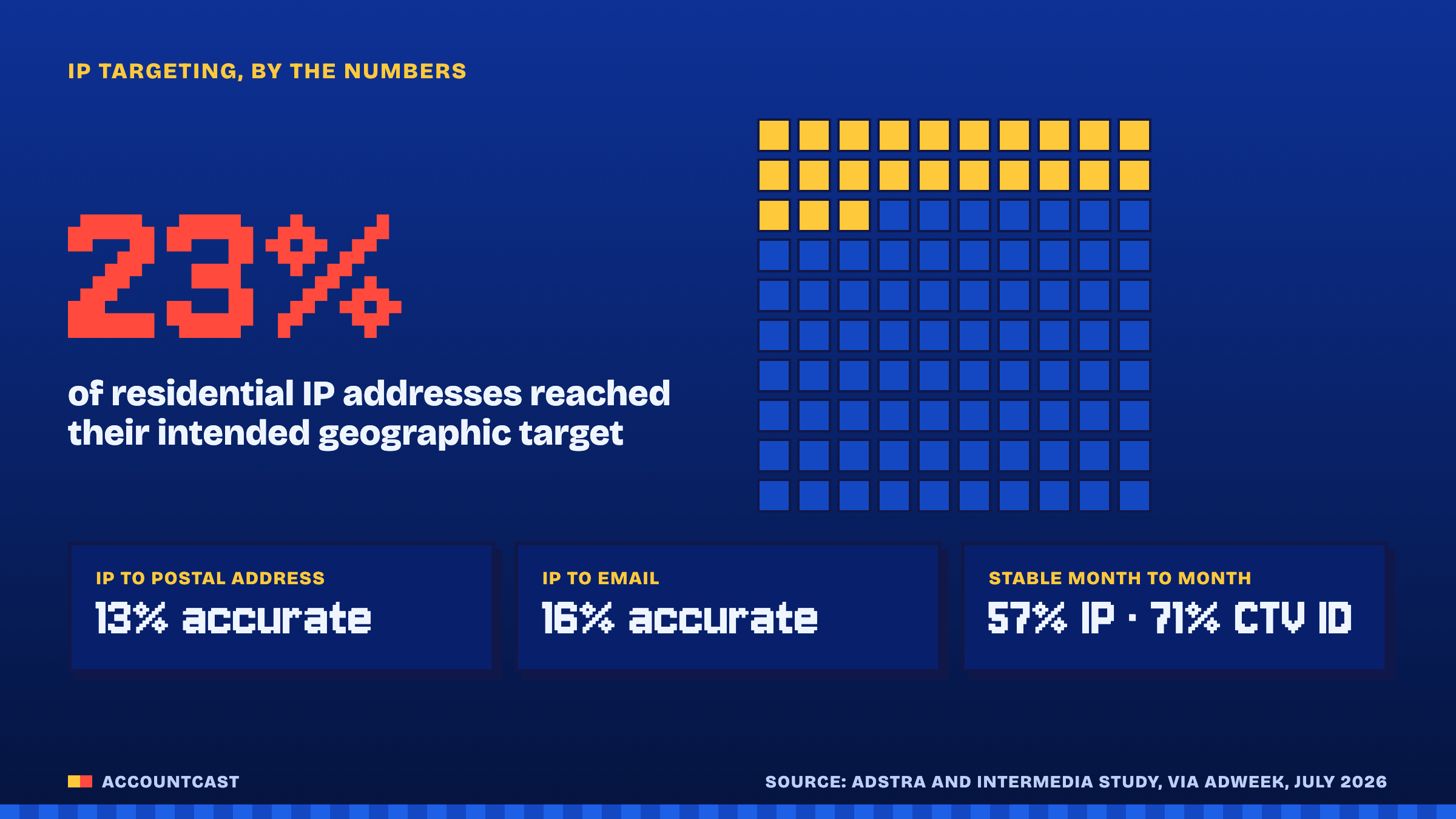
IP targeting for CTV is not very accurate: a 2026 study found that only about one in four residential IP addresses reached its intended geographic target. IP targeting means picking which homes or offices see an ad based on their internet address, either by matching a company's office IP ranges or by guessing a household from its home internet IP.
The study was run by Adstra and InterMedia Advertising and reported by Adweek in July 2026. It found that only 23% of residential IP addresses reached their intended geographic target. In the same study, matching an IP address back to a postal address was right 13% of the time, and matching an IP address to an email was right 16% of the time. The highest-quality CTV device identifiers held steady month over month 71% of the time, compared with 57% for IP addresses. In other words, the ID tied to a TV changed less often than the IP address, so it's a steadier thing to target.
Worth saying: Adstra sells identity resolution, so it has a stake in IP looking bad. Still, the numbers line up with what a lot of people in this business suspected. Truthset, which provided supporting analysis, estimated that about $7.4 billion of US programmatic CTV spend would be wasted in 2026.
Why doesn't office IP targeting work for B2B anymore?
Office IP targeting stopped working well for B2B because people started working from home and left their company's network. Office IP targeting finds office networks. A home IP address belongs to an internet provider, not to the company your buyer works for, so a reverse lookup can't tell you who lives there or where they work. AdExchanger was writing about this problem for ABM as soon as remote work took off.
That's why the better approach starts from people, not buildings. Your buyers' office IP doesn't tell you much anymore. Your buyers do.
Does Apple's iOS 27 affect CTV ads?
Apple's iOS 27 changes mostly don't affect ads on TV apps, because they target web browsers, but they do weaken website-pixel measurement and they favor first-party data like your CRM. With iOS 27, Apple's Safari and the WebKit engine behind it started blocking third-party companies that collect email addresses at logins and newsletter sign-ups and turn them into tracking IDs that follow people across websites. Apple is going after identity graph companies. An identity graph is a database that links one person's emails, devices and addresses together so they can be recognized in different places. Apple's list initially included The Trade Desk's ad-serving domain, adsrvr.org; an iOS 27.2 beta removes it, according to AdExchanger and PPC Land. Apple keeps the list in a file it can update whenever it wants.
What that means for TV:
It's aimed at web browsers, not TV apps. Your target account watching a show on their smart TV isn't using Safari.
It does affect website pixels. If part of your plan for proving TV worked is "watch for visits on our website," expect that signal to get weaker on Apple devices. That's a measurement problem more than a targeting one, and it's a good reason to measure in your CRM instead.
It points somewhere useful. Apple's problem is third parties holding people's identity across companies. The safest ground is data you already own: your CRM and your target account list. Starting from your own list holds up better when the rules change.
What should you ask a CTV vendor about how they match your accounts?
Ask any CTV vendor five things: what they start from, how they get from a company to a TV, what the match rate is on your list, whether they report by account, and what changes on Apple devices.
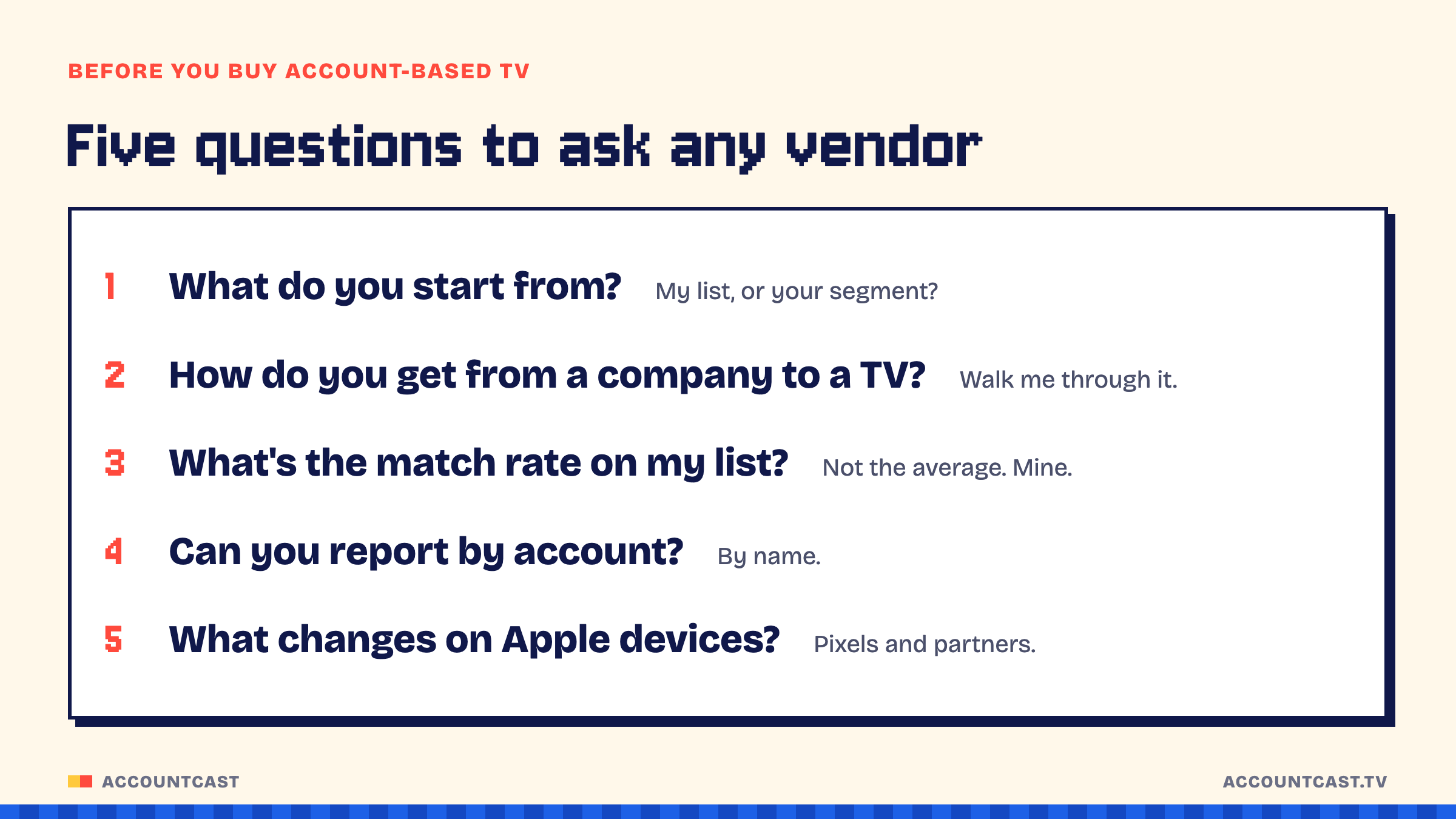
- What do you start from? My list, or a segment you built?
- How do you get from a company to a TV? Office IP, household IP, or people matched to homes? If they can't walk you through it, that's your answer.
- What's the match rate on my list? Ask for the account match rate, not just people, and ask for it on your list before you sign.
- Can you report by account? Which of my accounts were reached, by name.
- What changes on Apple devices? If they say "nothing," ask about their website pixels.
A good vendor will be glad you asked. A shaky one will start talking about how many households they reach.
Frequently asked questions
How does B2B CTV advertising reach specific companies?
B2B CTV advertising reaches specific companies by finding the people who work at those companies and matching them to the homes where they stream TV. Contact details are turned into private hashed IDs, which a streaming ad platform matches to households it can reach. The ad plays in those homes, and the results can be reported back by company. Older methods guess from office or home IP addresses, which are much less accurate.
What is a good match rate for account-based CTV?
A good account match rate is one where most of your target accounts have at least one person matched to a reachable home. Account match rate is different from people match rate, which is always lower. Results vary by industry, company size and roles, so ask any vendor to run your own list before you commit.
Is IP targeting accurate for connected TV ads?
IP targeting is not very accurate for connected TV ads. A study by Adstra and InterMedia Advertising, reported by Adweek in July 2026, found that only 23% of residential IP addresses reached their intended geographic target. The same study found IP-to-postal matching was right 13% of the time and IP-to-email matching 16% of the time. Adstra sells identity resolution, so it has a stake in the result.
Can account-based CTV prove that a specific person saw the ad?
No. Account-based CTV can show that an ad played in a matched household, but it cannot prove which person in that home was watching. A household match connects a person on your list to a home with a TV, and the home may be shared with a partner, roommates or kids. TV has always worked this way. Be wary of any vendor that claims person-level proof from a household match.
Does Apple's iOS 27 privacy update affect TV advertising?
Apple's iOS 27 update mostly does not affect ads that run inside TV streaming apps, because it targets web browsers built on Safari's WebKit engine. It blocks third parties that turn email addresses into cross-site tracking IDs. It does weaken website-pixel measurement on Apple devices, so measuring TV results through website visits gets less reliable. Measuring in your CRM, using accounts you already own, holds up better.
Why are B2B advertisers moving away from office IP targeting?
B2B advertisers are moving away from office IP targeting because many buyers now work from home, outside their company's network. Office IP targeting only finds people on the office network. A home IP address belongs to an internet provider, not the employer, so it cannot reveal where someone works. Matching the people at your target accounts to their homes reaches them where they actually watch TV.
Sources
- IP-based CTV targeting fails 3 in 4 times, Adstra study finds (PPC Land, reporting Adweek, July 2026)
- Why IP-based targeting is failing CTV campaigns (NewscastStudio)
- How CTV can help overcome the challenges of ABM in a work from home world (AdExchanger)
- Safari 27 blocks identity firms that turn email addresses into tracking IDs (PPC Land)
- How data and ad tech vendors are preparing for the iOS 27 fallout (AdExchanger)
- Apple asks The Trade Desk to test an iOS 27.2 build that may unblock ads (PPC Land)
- Adstra and InterMedia Advertising research announcement (MarTech Series)