Blog · Part 4 of 5
How to Tell If Your B2B TV Ads Are Working
A plain-English way to measure B2B CTV: three levels of proof, a simple holdout test, and a 90-day connected TV scorecard you can show your CFO.
Danny Stedman · · 10 min read
Short answer: You can tell if your B2B TV ads are working by checking three things in order: which of your target accounts were reached, whether those accounts behaved differently from accounts you held back, and whether their pipeline moved. The cheapest honest way to do this is a holdout test: run ads to part of your account list, keep the rest dark, and compare the two groups in your CRM over about 90 days.
Key takeaways
- B2B TV ads should be judged on accounts reached, account behavior and pipeline, not on clicks or impressions.
- A holdout test, where some target accounts deliberately see no TV ads, is the simplest honest way to measure whether TV made a difference.
- Your CRM is the best measurement tool for B2B TV, because stage changes and win rates don't depend on tracking a website visit.
- Vendor stats like "83% said they purchased after CTV exposure" describe people who saw ads; without a comparison group, they don't prove the ad caused anything.
- Website pixels are getting less reliable on Apple devices after Safari and WebKit 27, which is another reason to build proof on CRM data.
"83% purchased a product or solution after CTV exposure."
That's a real number from a real survey. It's very tempting to paste it into a budget slide. Don't. Not yet.
CTV (connected TV) means ads shown in streaming TV apps on internet-connected TVs and devices. It's one of the hardest B2B channels to measure. Nobody clicks a TV. The person who saw your ad on Tuesday night searches for you on Thursday from a work laptop, and your attribution tool hands the credit to Google.
How do you measure B2B CTV ads?
You measure B2B CTV ads on three levels of proof: whether you reached the target accounts, whether those accounts behaved differently, and whether pipeline moved. Think of it as a ladder. Each rung is harder to prove and worth more.
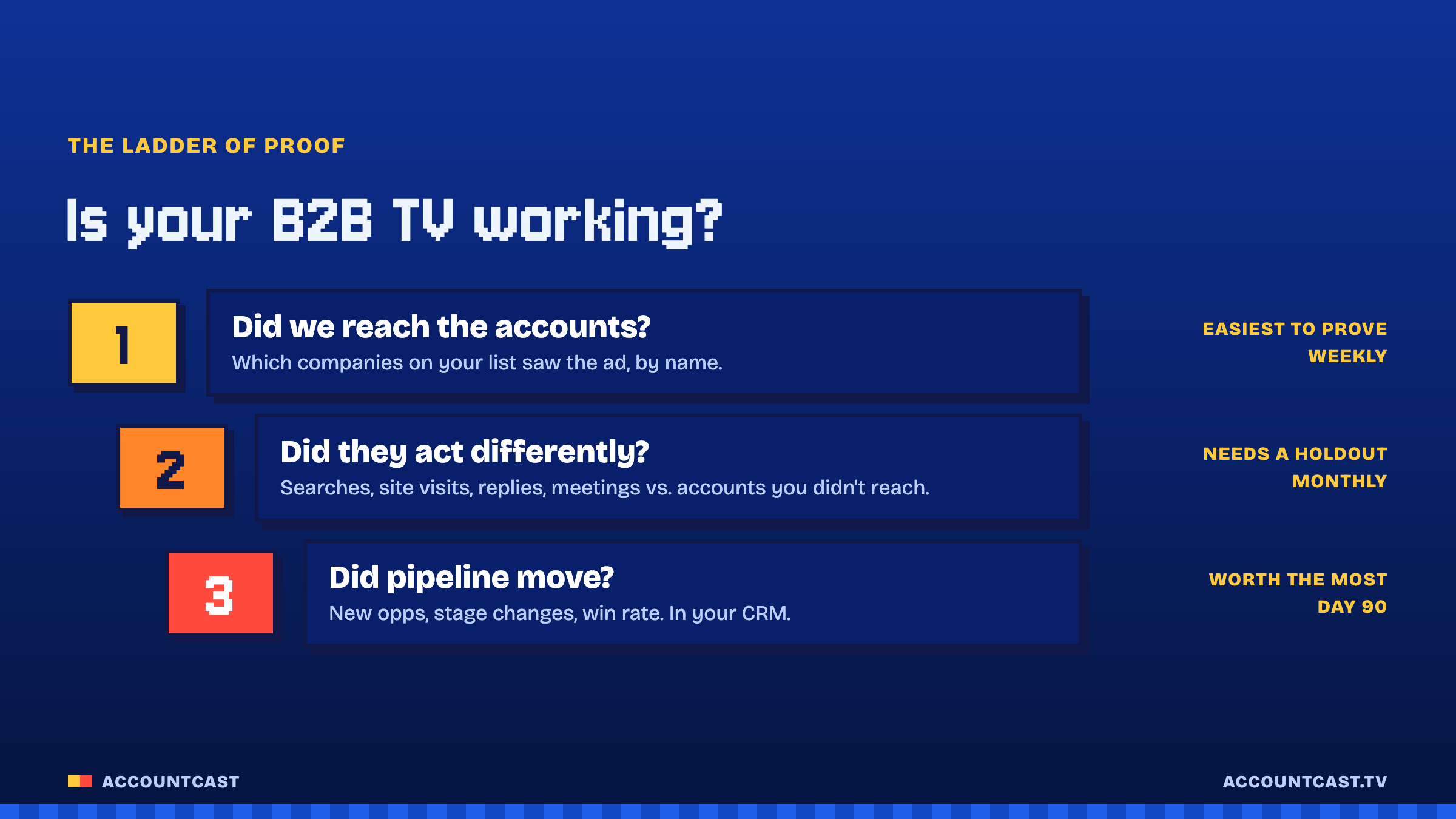
Level 1: Did we reach the accounts?
Not "how many impressions ran." Which of the companies on your list actually saw the ad, by name. If your vendor can only give you a campaign total, you're stuck at the bottom of the ladder before you start.
Know your ceiling first. Your match rate is the share of your list that can be reached at all, and it caps Level 1. If a vendor can match 80% of a 400-account list, only about 320 accounts are reachable before the campaign even starts.
Level 2: Did those accounts behave differently?
More branded searches, direct site visits, email replies and meetings. Activity always happens, so the real question is whether reached accounts did more than accounts you didn't reach.
Level 3: Did pipeline move?
Pipeline is the set of open sales opportunities your team is working on as they move toward a signed deal. Deals created, deals advancing a stage, deals closing. This is what your CFO cares about. It's also the slowest to show up, because B2B deals take months.
Most TV reporting stops at Level 1. Getting to Levels 2 and 3 takes a comparison.
What is a holdout test for TV ads?
A holdout test splits your target account list in two, runs TV ads to one group, keeps the other group dark, and compares the two groups later. The held-out group shows you what would have happened without TV.
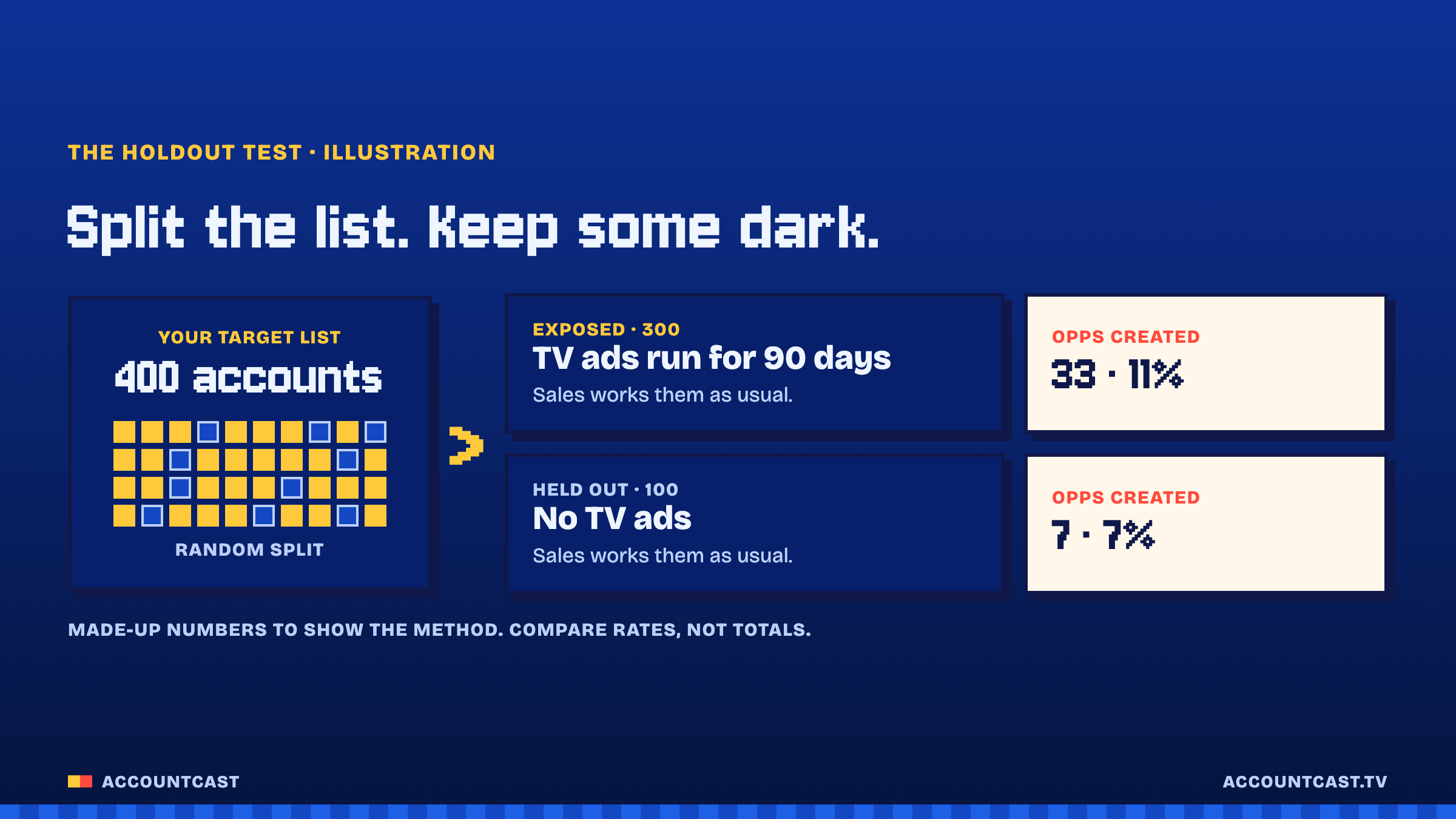
In the illustration above, which uses made-up numbers, a list of 400 accounts is split into 300 that see TV ads and 100 that don't, and the two groups are compared at day 90.
A few rules keep it honest:
- Split randomly, not by hand. If you put your favorite accounts in the TV group, of course they'll look better.
- Keep the groups similar. Same mix of company sizes, industries and deal stages. A random split usually takes care of this on a list of a few hundred accounts.
- Don't touch the holdout. Sales still works those accounts normally. You're only holding back the TV ads.
- Give it time. Growthspree's 2026 guide to B2B CTV recommends 90 days or more of continuous exposure, with holdout tests run over a similar window. A two-week test mostly measures noise.
Yes, some accounts go a quarter without your ads. That's the price of knowing, and it's cheaper than a year on a channel you can't prove. If a vendor resists a holdout, ask why.
What should a B2B CTV scorecard include?
A B2B CTV scorecard should track accounts reached, account behavior and CRM pipeline, each compared between exposed and held-out accounts over 90 days.
| What to track | Level | Where it comes from | Check it |
|---|---|---|---|
| Accounts reached, by name | 1 | Your TV vendor's report | Weekly |
| How often each account saw the ad | 1 | Your TV vendor's report | Weekly |
| Branded search and direct traffic from target accounts | 2 | Google Search Console, web analytics, account identification tools | Monthly |
| Meetings booked and sales email replies | 2 | Your CRM and sales tools | Monthly |
| New opportunities created | 3 | Your CRM | Monthly |
| Stage changes and days in stage | 3 | Your CRM | Monthly |
| Win rate, exposed vs held out | 3 | Your CRM | At day 90, then quarterly |
Notice what's doing the heavy lifting: your CRM. The best measurement tool for B2B TV is the one your sales team already lives in.
Others land in the same place. Directive's September 2026 article on CTV beyond awareness recommends measuring stage progression, days in stage, win rate, and exposed versus unexposed accounts. AI Digital argues CTV should be judged on search lift, direct traffic, close rates within targeted accounts and pipeline velocity, not clicks.
What metrics should you stop using for CTV?
Stop judging B2B CTV on click-through rate, long-window view-through conversions, raw impressions and completion rate on its own. They look like proof and aren't.
Click-through rate. People don't click TVs. Some TV formats don't even allow clicks. Optimizing for CTR on TV is like judging a billboard by how many people high-fived it.
View-through "conversions" with long windows. A view-through conversion is when someone saw the ad and later took an action, like visiting your site, without clicking anything. With a 30-day window, almost anyone on your list who visits your site gets counted, including people who were coming anyway. Without a holdout, you can't tell which is which.
Impressions as success. An impression is one showing of your ad. Impressions are what you bought, not what you got. Two million impressions sounds great until you learn most of them landed on the same 40 households, or on households that were never on your list.
Completion rate on its own. Non-skippable TV ads get finished almost every time, so a high completion rate doesn't tell you much.
Why is website pixel tracking getting less reliable?
Website pixel tracking is getting less reliable because Apple's Safari and WebKit 27 release blocks third parties that turn email addresses into persistent tracking IDs.
A lot of B2B TV measurement leans on a website pixel: the ad runs, the vendor watches for a visit from the same household, and calls it a win.
According to PPC Land's coverage in October 2026, Safari and WebKit 27 block identity companies including LiveRamp, Permutive and Audigent. AdExchanger reported in October 2026 that data and ad tech vendors are scrambling to prepare, and Apple can update the blocked list whenever it wants.
This affects web browsers on Apple devices, not the TV apps your ads run in. But "they saw the ad, then visited the site" depends on spotting that visit, and more of those visits are getting harder to see.
Your CRM doesn't have that problem. A meeting booked is a meeting booked, whatever browser someone used.
How do you read a vendor's CTV statistic?
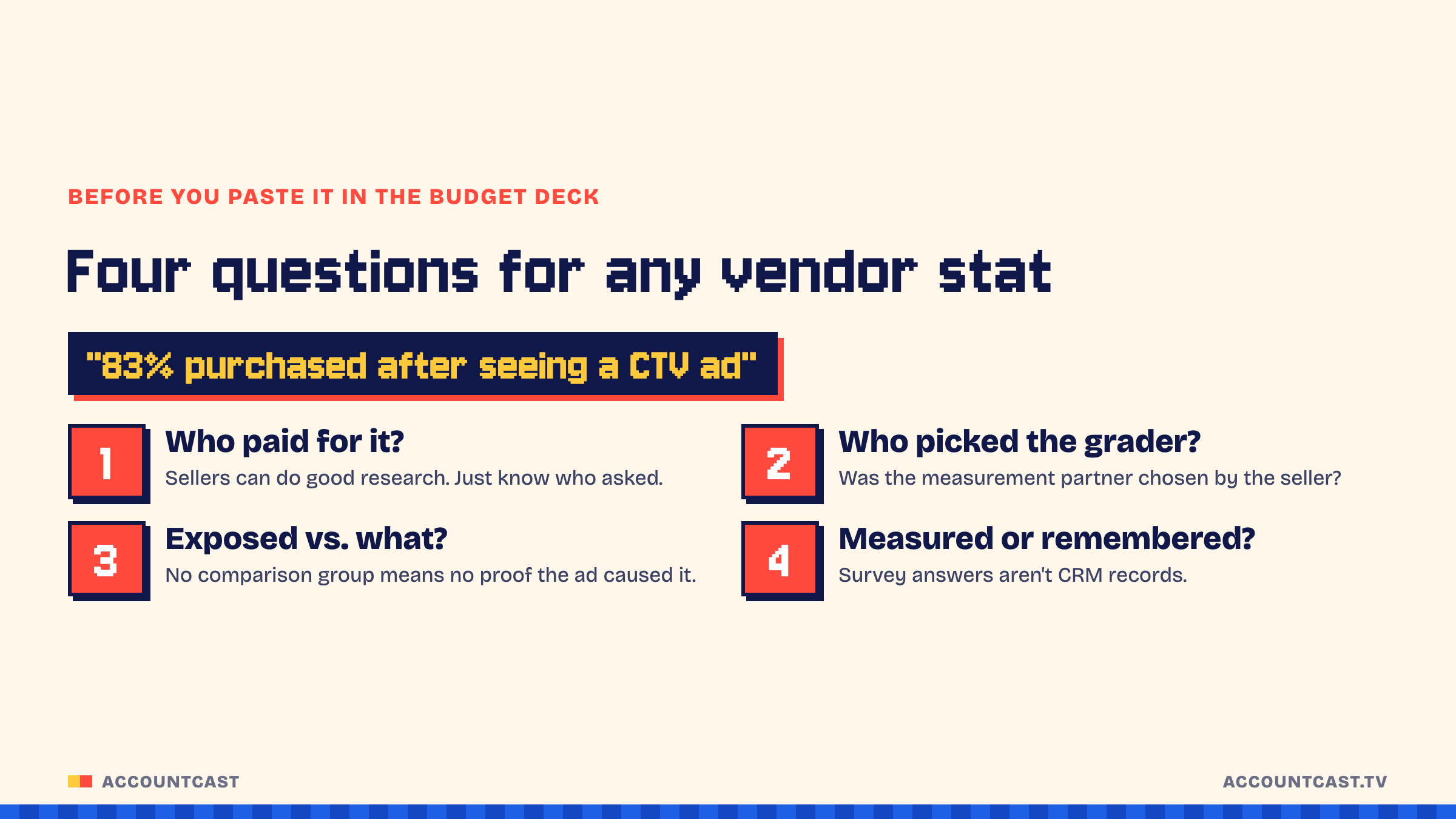
Read any CTV statistic by asking four questions: who paid for it, who picked the measurement partner, what the exposed group was compared to, and whether the result was measured or self-reported.
Back to that 83%. In an October 2024 study by MAGNA and LinkedIn, 98% of LinkedIn users surveyed said they watch connected TV weekly. In the same study, 79% said they started a free trial and 83% said they purchased a product or solution after CTV exposure. It's useful research. Before quoting it, run it through the four questions.
1. Who paid for it?
This study was a collaboration with LinkedIn, which sells CTV ads. That doesn't make it wrong, but the sponsor had a reason to care about the answer.
2. Who picked the measurement partner?
The study was run by MAGNA, a media agency, together with LinkedIn. More broadly, LinkedIn's April 2024 announcement names iSpot and Kantar as its CTV measurement partners. Good firms, still chosen by the seller.
3. Exposed compared to what?
"83% purchased after exposure" doesn't say how many would have purchased anyway. Without a comparison group, it describes people. It doesn't prove the ad caused anything.
4. Was it measured or remembered?
Survey answers are what people say they did. CRM records are what actually happened.
Here's what good reporting looks like. Kiin studied 118 LinkedIn CTV campaigns across 31 advertiser accounts between September 2025 and September 2026. When it tested whether CTV lifted the same advertisers' feed campaigns, across 26 accounts, it reported plainly: "no halo found." Kiin also said post-view conversions should be read as "evidence of lift," not as "attributable leads."
That's the tone you want: clear about what it can show and what it can't.
Can CTV be measured accurately?
CTV can't be measured perfectly, but it can be measured well enough to answer "is this working?" by comparing reached accounts with held-out accounts in your CRM.
Demandbase, one of the bigger ABM (account-based marketing) platforms, has said openly that CTV measurement is "not perfect." Fair. But "not perfect" isn't "can't be measured."
So here's the bottom line. Get a report that names the accounts you reached. Hold back part of your list. Give it 90 days. Then compare the two groups in your CRM. If the reached accounts book more meetings and move more deals, TV is working. If they don't, you'll know that too, and you'll know it from your own data.
Frequently asked questions
How long should a B2B CTV test run?
A B2B CTV test should run for about 90 days or longer. Growthspree's 2026 guide to B2B CTV recommends at least 90 days of continuous exposure, and B2B deals often take months to move. A two-week test mostly measures noise. Plan to check accounts reached weekly, account behavior monthly, and win rates at day 90 and then quarterly.
What is a good holdout size for a CTV test?
There's no single right size. The example in this guide holds back 100 of 400 accounts, about a quarter, but the right size depends on your list: bigger holdouts give clearer answers, smaller ones keep more accounts in market. Split the list randomly so both groups have a similar mix of company sizes, industries and deal stages. Sales keeps working the held-out accounts normally; only the TV ads are held back.
Can you track clicks from TV ads?
No, not in any meaningful way. People don't click TVs, and some connected TV ad formats don't allow clicks at all. Click-through rate is the wrong metric for TV. Instead, compare branded search, direct website traffic, meetings booked and CRM pipeline between target accounts that saw your TV ads and a held-out group that didn't.
What is a view-through conversion?
A view-through conversion is when someone sees an ad and later takes an action, like visiting your website, without clicking the ad. It's useful but easy to overcount. With a long window, such as 30 days, many people who were already going to visit get counted. A holdout group is the best way to tell real lift from visits that would have happened anyway.
Does Apple's iOS 27 affect CTV ad measurement?
Partly. Apple's iOS 27 update ships Safari and WebKit 27, which block third parties that turn email addresses into persistent tracking IDs, which makes website-pixel measurement harder on Apple devices. The block is aimed at web browsers, not the TV apps where ads run. Measurement built on CRM data, like meetings, stage changes and win rates, isn't affected because it doesn't depend on tracking a browser visit.
Should I trust vendor CTV statistics?
Treat vendor CTV statistics as a starting point, not proof. Ask who paid for the study, who chose the measurement partner, what the exposed group was compared to, and whether results were measured or self-reported in a survey. A stat can be accurate and still not show that the ads caused anything. Your own holdout test on your own accounts is the stronger evidence.
Sources
- MAGNA with LinkedIn: CTV ad effectiveness for B2B (Oct 2024)
- Kiin: LinkedIn CTV Ads 2026 benchmarks (31 accounts)
- Growthspree: CTV and programmatic advertising for B2B SaaS 2026
- Directive: CTV for B2B beyond awareness (Sep 2026)
- AI Digital: The Amazon-LinkedIn CTV alliance
- Demandbase: CTV in B2B advertising
- LinkedIn: CTV and Live Event Ads (Apr 2024)
- PPC Land: Safari 27 blocks identity firms
- AdExchanger: How data and ad tech vendors are preparing for the iOS 27 fallout