Blog · Part 5 of 5
What to Say in a B2B TV Ad
How to write connected TV (CTV) spots for B2B buyers, with three sample scripts for three stages of the deal.
Danny Stedman · · 10 min read
Short answer: A B2B TV ad should say one thing, make it funny or human, show your logo in the first few seconds, and end with one clear next step. In a 2024 MAGNA and LinkedIn study, funny ads scored highest with business decision makers watching connected TV. The best B2B teams also write a different spot for each deal stage: buyers who've never heard of you, buyers in an open deal, and buyers whose deal has stalled.
Key takeaways
- A 2024 MAGNA and LinkedIn study found funny ads indexed at 131 with business decision makers on connected TV, against a baseline of 100.
- A B2B TV ad should carry one idea, show the logo early, and put the key line both on screen and in the voiceover.
- Teams should make a 15-second and a 30-second version of each ad and test both.
- A B2B TV ad works best when it matches the deal stage: be remembered, reassure the buying committee, or answer the one objection that's stuck.
- Sales teams should know when a TV ad is running, so reps can mention it on their next call.
Most B2B TV ads are a webinar with music.
A logo. A slow pan across a dashboard. A voiceover saying "unlock" and "seamless" and "at scale." Then a URL nobody will type.
It's a shame, because the person watching is your buyer, at home, relaxed, actually paying attention. That moment deserves better than a product tour.
A quick definition first. Connected TV (CTV) means TV watched through an internet connection: streaming apps on a smart TV, a streaming stick, or a game console. A spot is just the ad itself, usually 15 or 30 seconds long.
What makes a good B2B TV ad?
A good B2B TV ad is one sharp, human idea that the viewer remembers, not a list of features.
Do funny B2B ads actually work?
Yes: in MAGNA and LinkedIn's 2024 study, funny ads beat every other style with business decision makers.
MAGNA and LinkedIn published research in October 2024 on how business decision makers respond to connected TV ads. Against a baseline of 100, funny ads indexed at 131, emotionally appealing ads at 111, and ads with relatable characters at 109.
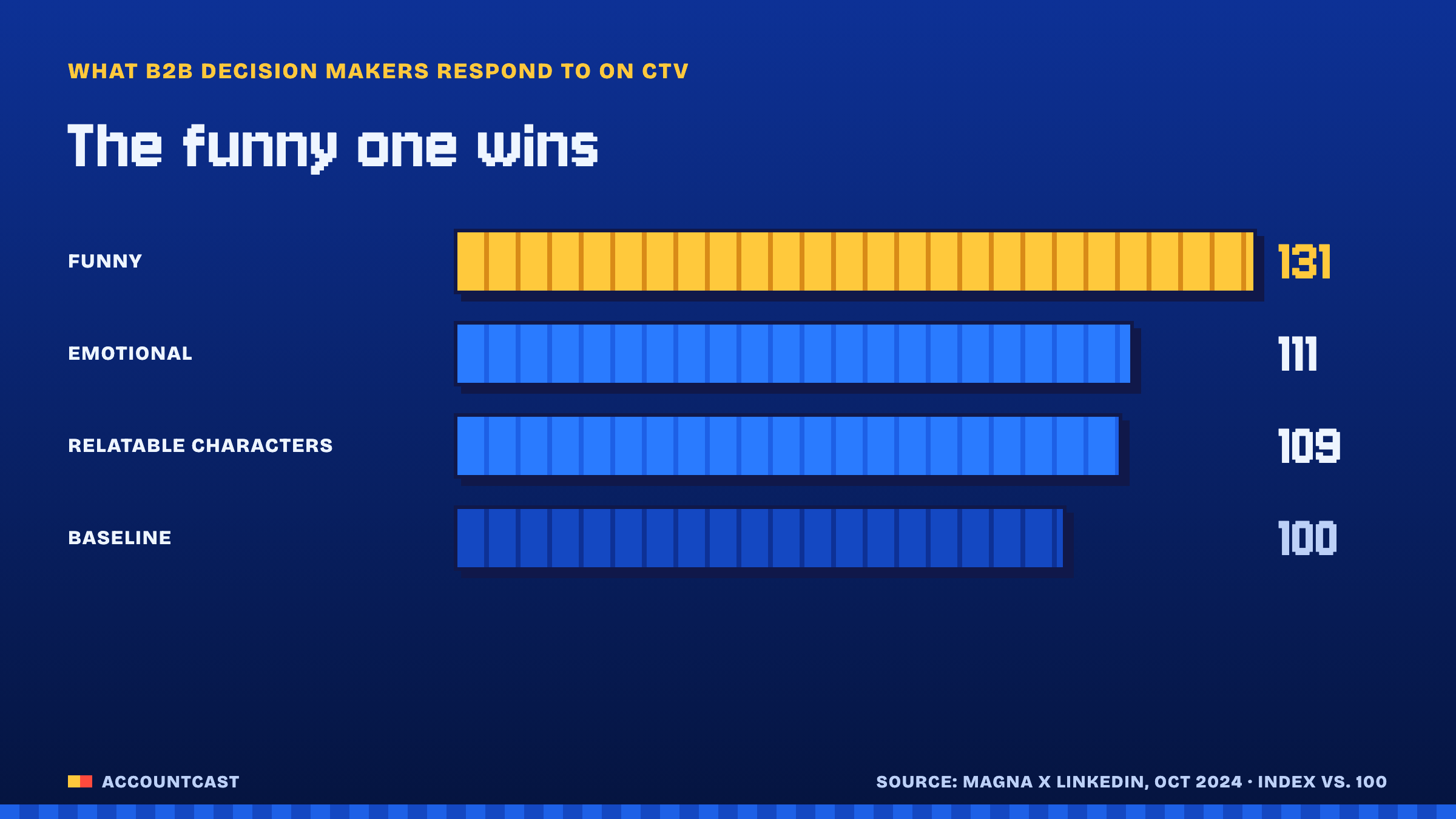
Read that again. The buyer approving a six-figure software contract responds best to the same thing everyone responds to on a Tuesday morning. A joke.
Who is watching B2B ads on connected TV?
According to the same MAGNA and LinkedIn study, 52% of the LinkedIn CTV viewers surveyed were Millennials.
That's not the stereotype of a 60-year-old executive watching the evening news. These are people who grew up on streaming, skip anything boring, and know when they're being sold to.
The study also reported that 98% of the LinkedIn users surveyed watch connected TV weekly. Among decision makers watching CTV to stay informed, 52% tuned in early in the morning, and 69% and 66% were watching educational and news content. MAGNA points to those slots for the most receptive audience.
So aim for a sharp, funny, human spot, written for someone half-awake with a coffee or watching a documentary.
A fair note: this research was a partnership between LinkedIn and MAGNA, so treat the exact numbers as directional. The direction matches what anyone who's watched TV already knows. Nobody remembers the dashboard pan.
What are the rules for a B2B CTV ad?
The rules that matter are one idea, logo early, say it and show it, one clear next step, and two lengths.
The CTV creative guides from Bombora, RollWorks and AdRoll, plus iSpot's advice on 15-second ads, broadly agree on these.
One idea. Not three. The guides say two messages max. I'd say one, and let the landing page, your sales team and your follow-up do the rest.
Logo early. People decide fast whether an ad is worth watching. Put your name in the first few seconds, and keep a small logo in the corner the whole way through.
Say it and show it. Use a voiceover and put the key line on screen as text. Half your viewers are folding laundry. The other half have the sound low.
One clear next step. On screen and out loud. A short URL works, or a QR code call to action, which is a scannable square on screen that opens your page on the viewer's phone. "Learn more" isn't a next step.
Two lengths. More on that below.
How long should a CTV ad be?
Make both a 15-second and a 30-second version, because one will work better for you and you can't know which until you test.
Write the 30-second version first, then cut it down to 15. Run both. The 15 forces you to find the one idea. The 30 gives you room for proof.
Should B2B TV ads change by deal stage?
Yes: a buyer who has never heard of you needs a different message than a buyer six weeks into evaluating you, or a buyer whose deal has stalled.
Here's where most B2B TV goes wrong. One spot runs to everyone, all year.
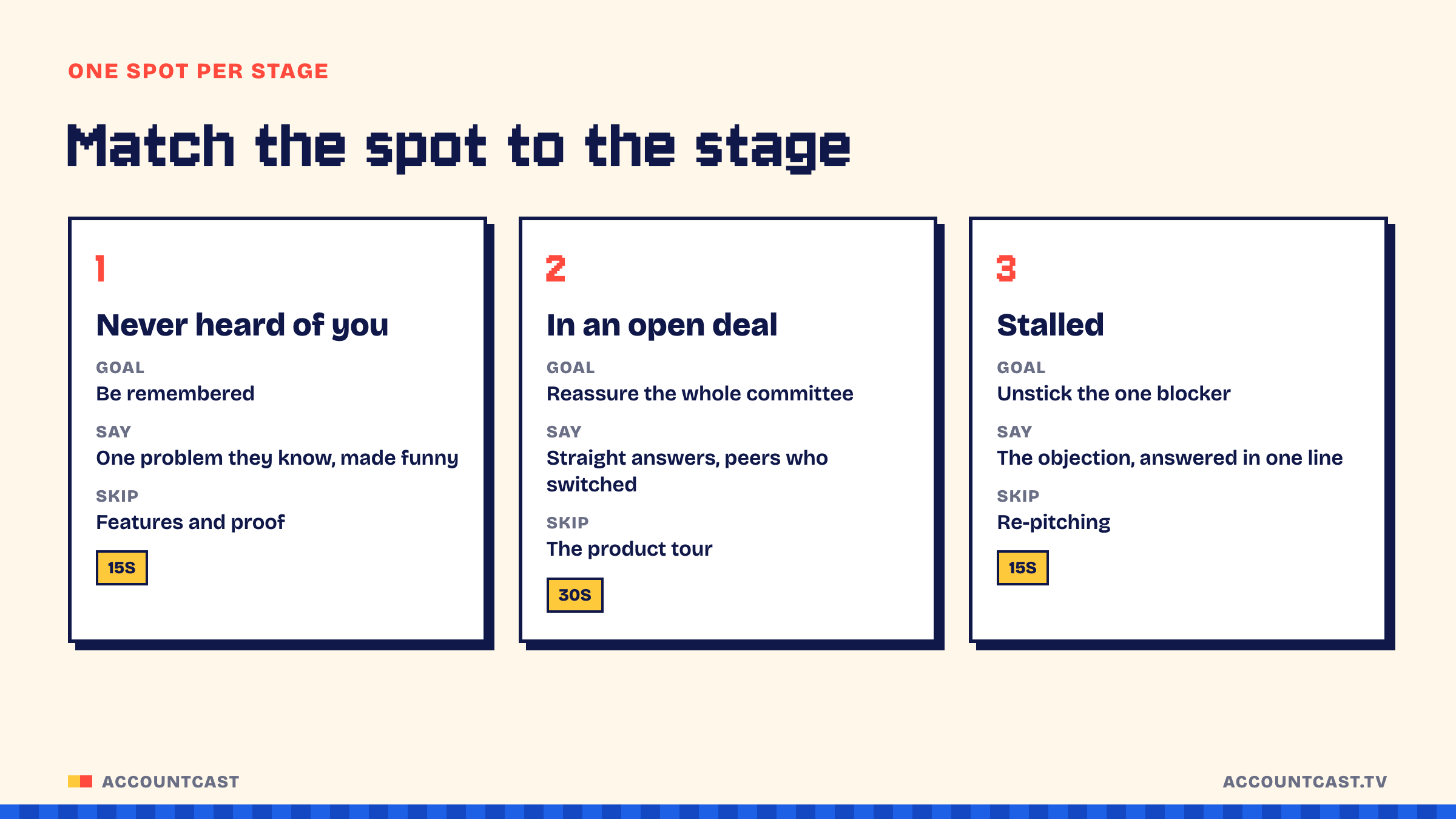
The three stages and their jobs:
- Never heard of you: be remembered. One funny problem they recognize.
- In an open deal: reassure the whole buying committee with proof and peers.
- Stalled: name the objection that's stuck and answer it in one line.
A buying committee is the group of people at a company who weigh in on a purchase, often far more than the one or two people your sales rep talks to. If your TV platform can target specific accounts, you can match the spot to the stage. Your CRM already tells you which accounts sit where. Directive makes a similar point about role-specific creative that handles objections and shows proof.
What should a B2B CTV ad script look like?
A B2B CTV ad script is a short table of time, visual and audio, built around one idea for one deal stage.
Below are three sample scripts. The companies are made up. Steal the structure, not the jokes (actually, steal the jokes too).
Script 1: They've never heard of you
Goal: be remembered. One sharp problem they recognize, made funny. No proof, no features.
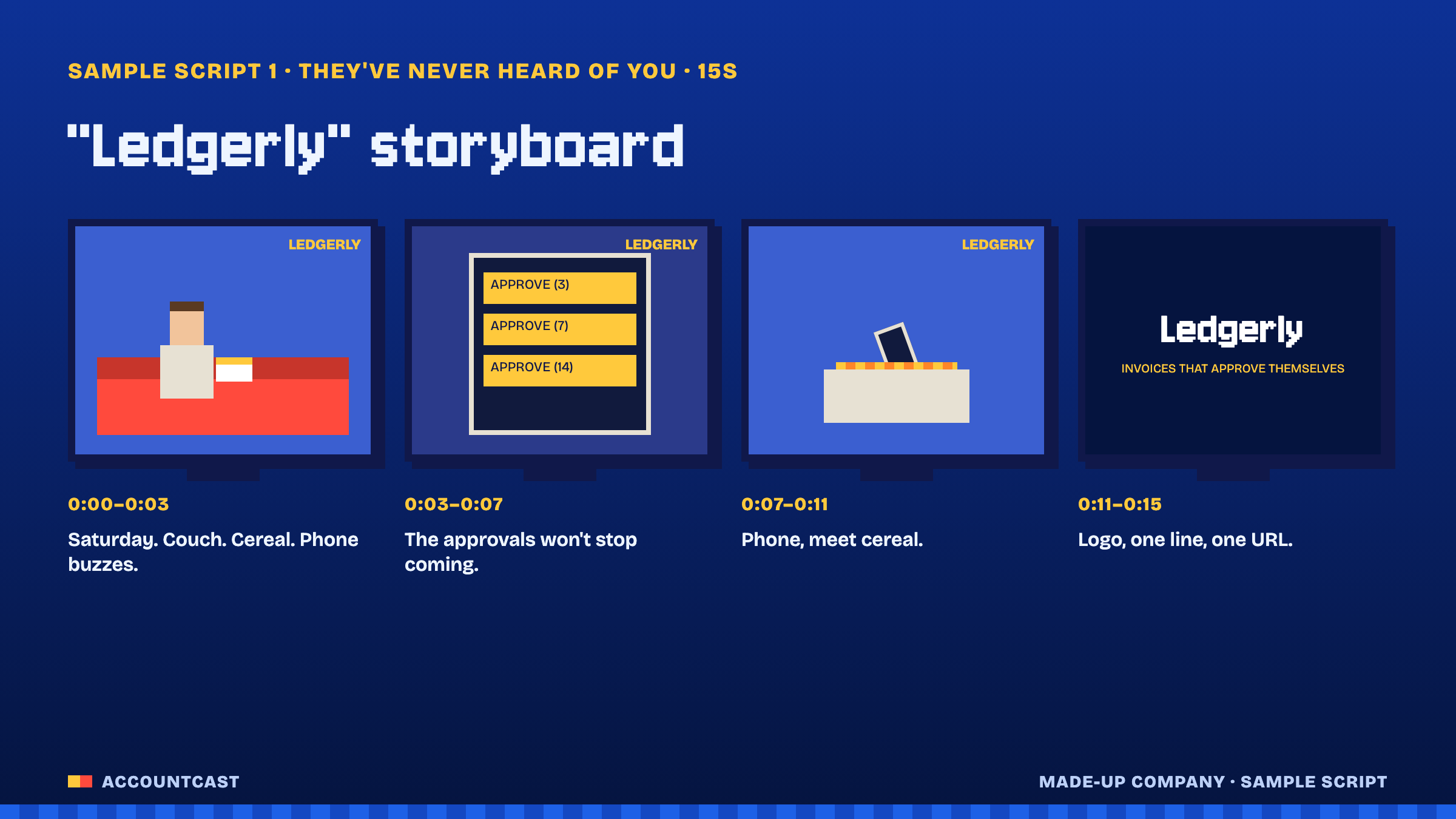
Ledgerly (made up) automates invoice approvals for finance teams. 15 seconds.
| Time | Visual | Audio |
|---|---|---|
| 0:00–0:03 | Saturday morning. A finance director on the couch in a robe, cereal in hand. Small Ledgerly logo in the corner. Her phone buzzes. | SFX: bzzt. |
| 0:03–0:07 | Close on the phone: "Invoice approval needed (3)." Then (7). Then (14). It won't stop. | SFX: bzzt bzzt bzzt. |
| 0:07–0:11 | She calmly lowers the phone into the cereal bowl. | VO: "If your weekend has an approval queue, your month-end does too." |
| 0:11–0:15 | Ledgerly logo. On screen: Invoices that approve themselves. ledgerly.com | VO: "Ledgerly. Invoices that approve themselves." |
Why it works: everyone in finance has lived this. No one needs to know how the product works yet. They just need to remember the name next time the phone buzzes.
Script 2: They're in an open deal with you
Goal: reassure the whole buying committee, including the people your sales rep has never met. Proof and peers, not pitch.
Shiftwell (made up) sells workforce scheduling to operations teams. 30 seconds.
| Time | Visual | Audio |
|---|---|---|
| 0:00–0:05 | An IT director brushing his teeth, staring into the mirror like he's rehearsing for a fight. Shiftwell logo in the corner. | Him, mouth full of toothpaste: "But how does it integrate with our HR system?" |
| 0:05–0:10 | Cut to a finance lead on a morning jog, muttering. | Her, out of breath: "And what's the real cost in year two?" |
| 0:10–0:15 | Cut to an ops manager in the car, waiting for the light to change. | Him: "And who's actually using this?" |
| 0:15–0:24 | Split screen, all three. Text pops in, one line each: [Your integration answer]. [Your pricing answer]. [Three peers in their industry who switched]. | VO: "Every buying team asks the same three questions. We've got straight answers to all of them." |
| 0:24–0:30 | Shiftwell logo. On screen: The answers your team is asking for. shiftwell.com/answers | VO: "Shiftwell. Ask us anything." |
Why it works: buying groups are big. Gartner puts a typical buying group for a complex B2B purchase at six to 10 decision makers. Your rep talks to one or two of them. This spot talks to the rest, at home, and answers the questions they'd never send in an email.
Swap the brackets for your real answers. Real customer names in their industry beat any adjective.
Script 3: The deal stalled
Goal: remove the one thing that's stuck. Name the objection. Answer it in one line.
Crateline (made up) sells logistics software. The deal has been sitting in security review for six weeks. 15 seconds.
| Time | Visual | Audio |
|---|---|---|
| 0:00–0:04 | A kid's pillow fort in a living room. A cardboard sign taped to it: SECURITY REVIEW. NO ENTRY. Crateline logo in the corner. | Kid, from inside the fort: "Password?" |
| 0:04–0:09 | A parent slides a thick binder under the blanket. The sign flips to: APPROVED. | VO: "Security review taking forever? We already did the homework." |
| 0:09–0:15 | Crateline logo. On screen: Security docs, ready before you ask. crateline.com/security | VO: "Crateline. Ready when your security team is." |
Why it works: it doesn't re-pitch the product. Everyone on the account already knows the product. It tells the people holding the deal up that their concern has been handled, and gives them a link to check it themselves.
Tell your sales team before this runs. A rep who can say "you might have seen our spot about security" on the next call has a great reason to follow up.
How do you make a B2B TV ad without a video team?
You have three options: adapt video you already have, use a tool that builds a spot from your website, or hire someone who writes for TV.
Adapt what you have. Got a customer video, a launch film, or a social cut? Trim it to one idea, add your logo up front, add on-screen text, and end on a clear next step. It's a fine place to start testing.
Use an AI video tool. Several now turn your website and brand assets into a TV-ready spot without a shoot. Good for early tests and for making several versions, like one per stage.
Have it made. For your main spot, the one most accounts will see, pay someone who writes for TV. A good script is most of the work. Bring them the stage, the one idea, and the objection you keep hearing.
Whichever you pick, check that the final file meets your platform's specs. CTV is fussy about format.
The bottom line
One idea, logo early, written for the stage the deal is in. Your buyer is at home, paying attention. Don't waste it on a dashboard pan.
Frequently asked questions
What should a B2B TV ad say?
A B2B TV ad should say one memorable thing about a problem your buyer recognizes, then tell them what to do next. Keep features and proof for the landing page and sales follow-up. Put your logo in the first few seconds, repeat the key line on screen and in the voiceover, and match the message to the buyer's deal stage: never heard of you, in an open deal, or stalled.
Do funny ads work for B2B buyers?
Funny ads appear to work well for B2B buyers. In a 2024 MAGNA and LinkedIn study of business decision makers on connected TV, funny ads indexed at 131 against a baseline of 100, ahead of emotional ads at 111 and relatable characters at 109. It was a LinkedIn and MAGNA partnership, so treat the exact numbers as directional, but the pattern is clear.
How long should a B2B connected TV ad be?
Make both a 15-second and a 30-second version of a B2B connected TV ad. Write the 30-second cut first, then trim it to 15 seconds, and run both to see which performs better for your audience. The 15-second version forces a single clear idea. The 30-second version leaves room for proof, like peer companies or a direct answer to an objection.
When do business decision makers watch connected TV?
In a 2024 MAGNA and LinkedIn study, decision makers watching connected TV to stay informed most often tuned in early in the morning (52%), and were watching educational (69%) and news (66%) content. The same study found 52% of the LinkedIn CTV viewers surveyed were Millennials, and 98% of the LinkedIn users surveyed watch connected TV weekly. The research was a partnership between LinkedIn and MAGNA, so treat it as directional.
Should I use a different TV ad for each deal stage?
Yes. Use different TV ads for different deal stages if you can target by account. Accounts that have never heard of you need a memorable problem. Accounts in an open deal need reassurance and peer proof for the whole buying committee. Stalled deals need the one blocking objection named and answered. Your CRM tells you which accounts sit in which stage, and an account-based TV platform lets you target them that way.
Can I make a B2B TV ad without a video production team?
Yes. You can adapt existing video, such as a customer story or social cut, by trimming it to one idea and adding an early logo, on-screen text and a clear next step. You can also use a tool that builds a TV-ready spot from your website, or hire a writer who works in TV for your main spot. Check your platform's file specs either way.
Sources
- MAGNA with LinkedIn: Explore CTV ad effectiveness for B2B (Oct 2024)
- Bombora: CTV in B2B advertising
- iSpot: 5 best practices to ensure success with 15-second video ads
- RollWorks: CTV creative best practices
- AdRoll: CTV creative best practices
- Directive: CTV for B2B beyond awareness (Sep 2026)
- Gartner: The B2B buying journey