Blog · Part 2 of 5
How to Use TV Ads to Help Close Deals in Your Pipeline
Four bottom-of-funnel CTV plays for B2B teams: open opportunities, stalled deals, live sales sequences, and renewals. Who to target, what to say, and what to watch in your CRM.
Danny Stedman · · 10 min read
Short answer: Yes, TV ads can help close B2B deals, if you aim them at accounts already in your pipeline instead of at strangers. The four plays are open opportunities, stalled deals, accounts in live sales sequences, and expansion and renewals. Each one uses a list pulled from your CRM, an ad that matches the deal stage, and one CRM number to judge it by.
Key takeaways
- Connected TV (CTV) ads can be aimed at specific accounts in your sales pipeline, not just used for awareness.
- The four bottom-of-funnel plays are open opportunities, stalled deals, live sales sequences, and expansion and renewals.
- Each play needs its own message: proof for open deals, the answered objection for stalled deals, simple familiarity for sequences, and results for renewals.
- Judge each play on one CRM number you pick before launch, comparing reached accounts with similar accounts that didn't see the ads. Never judge it on clicks.
- Tell your sales team which accounts are seeing the ads, so reps can use it in their next conversation.
TV ads usually get sold to B2B teams as "awareness."
That's fine. But your best accounts aren't strangers. They're in your pipeline. Some are one meeting away from signing, and some went quiet three weeks ago.
Those are the accounts worth reaching on TV. This post is four ways to do it.
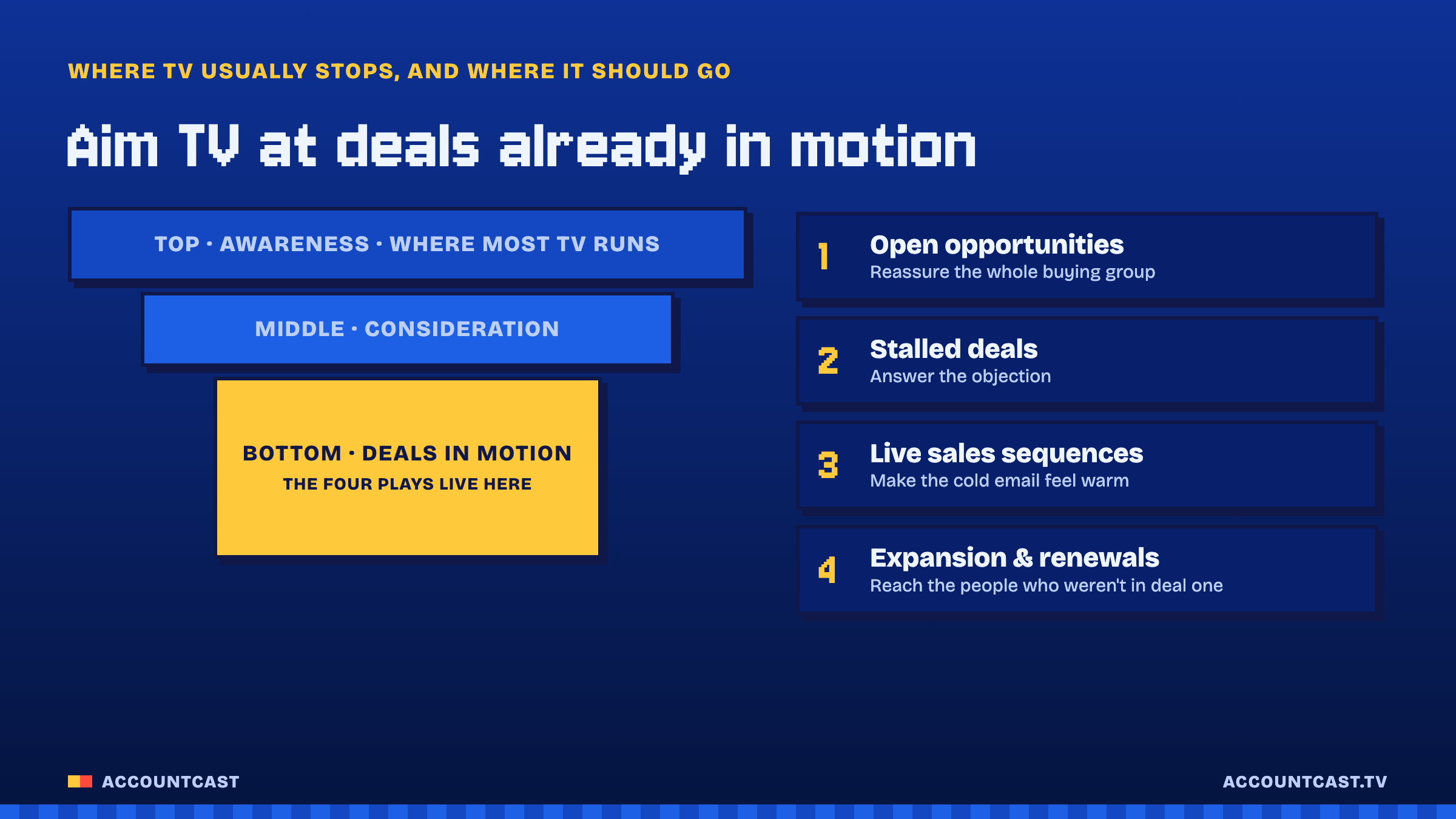
What does "bottom of the funnel" mean for TV ads?
Bottom of the funnel means accounts that are already close to a buying decision, such as open deals and renewals, as opposed to companies that have never heard of you. Connected TV, or CTV, means ads that play on streaming TV services (on a smart TV or a streaming device) instead of cable or broadcast. Put together, bottom-of-funnel CTV means running streaming TV ads at the specific companies your sales team is already working.
Can CTV ads help close B2B deals?
Yes, because most of a B2B buying decision happens when you're not in the room, and TV can reach the people making it. Gartner found that B2B buyers spend only 17% of their buying time meeting with potential suppliers. That 17% is split across every vendor they're looking at, so when they're comparing several, any one supplier may get just 5% or 6%.
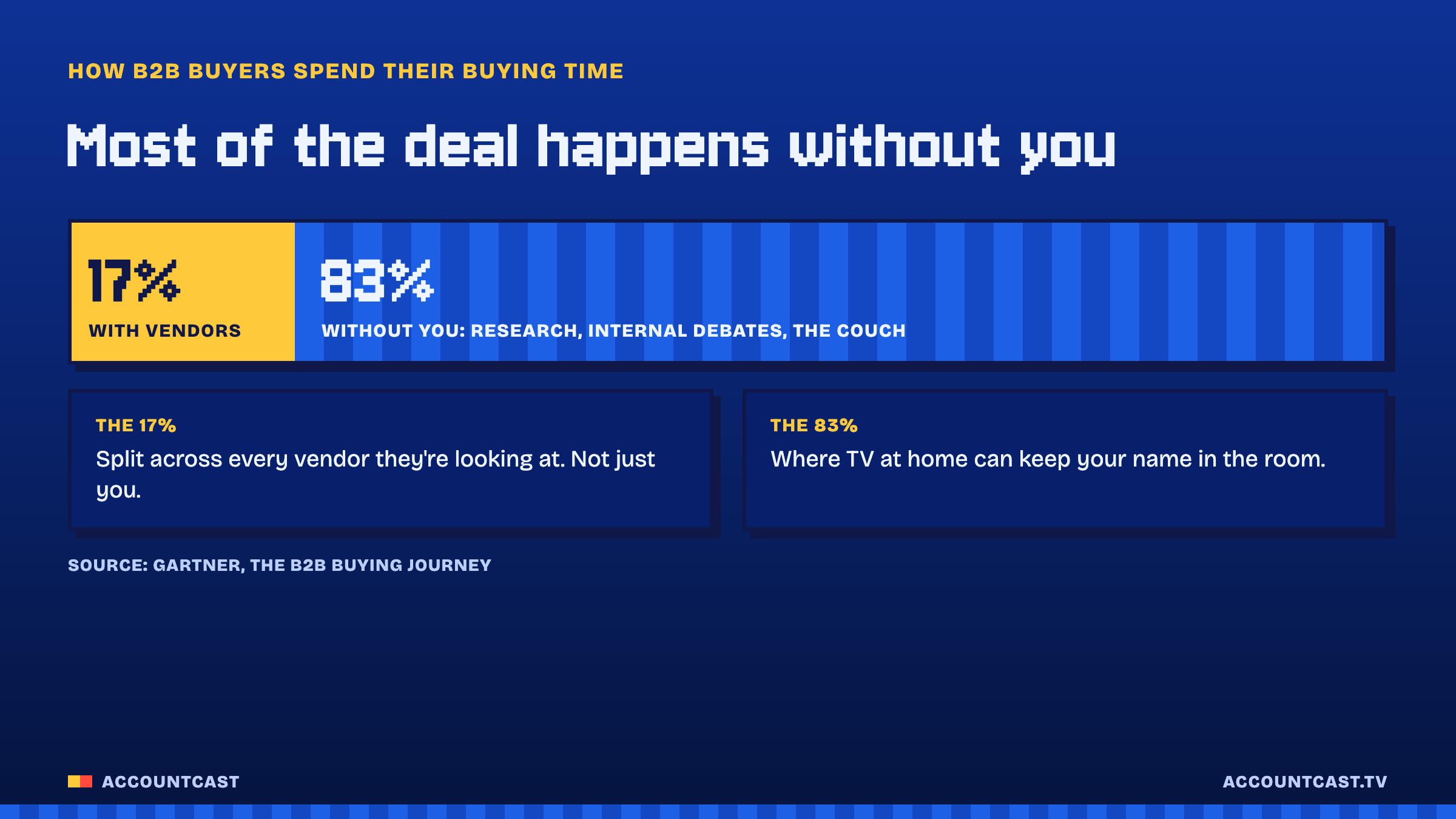
So about 83% happens without you. They're reading, comparing notes with each other, and arguing in meetings you'll never see. And some of that time, they're at home on the couch.
A buying committee is the group of people at one company who weigh in on a purchase. Gartner puts a typical buying group for a complex B2B purchase at six to 10 decision makers. Your rep is usually talking to two or three of them. The rest know your company from whatever reaches them on their own time.
Streaming TV reaches them at home, and most CTV ads can't be skipped. That's a deal support idea, not just an awareness one.
Credit where it's due: Directive's Michael Warford wrote a smart piece in September 2026 on "opportunity acceleration" with CTV, measured by stage progression and win rate. What I couldn't find was the practical part: which accounts, what message, how long, and which number to watch. So here it is.
How does account-based TV targeting work?
Account-based TV targeting shows your ad on streaming TV in the homes of people who work at the specific companies on your list. Every play below starts the same way: you pull a list of accounts from your CRM, an account-based CTV platform matches people at those accounts to their homes and runs your ad there, then it reports which accounts were reached.
The only thing that changes from play to play is which accounts go on the list, and what the ad says.
Play 1: How do you use TV ads on open opportunities?
Run reassuring, proof-based ads at accounts with an open deal, lightly, for as long as the deal is open. An open opportunity is a deal your sales team is actively working in the CRM.
Who's on the list: accounts with an open opportunity past your first real stage. Discovery done, demo booked, proposal out. Whatever "this is real" means in your CRM.
What the ad says: reassurance, not a product tour. They've seen the demo. Give them proof from companies like theirs, or "here's what happens after you sign." There's a sample script for this stage in the creative guide.
Timing: run it while the deal is open, and keep the frequency light. A few times a week per household is a reasonable starting point to test, not a benchmark. You want "oh, I keep seeing these guys," not "please stop."
What to watch in your CRM: days in stage and win rate. Compare reached accounts against similar open deals that weren't on the list, using a holdout test.
The people this helps most are the ones your rep never meets, like the CFO who signs off. They've heard your name in a meeting. Now they've seen you on TV too.
Play 2: How do you use TV ads on stalled deals?
Run a short burst of ads that answers the objection stalling the deal, timed with one fresh outreach from the rep.
Who's on the list: open opportunities with no meaningful activity in 30 days or more. No replies, no meetings, no movement. Every pipeline has a pile of these.
What the ad says: the objection you keep hearing, answered in one line. Stalling on "too hard to switch"? The spot is about easy switching. Ask your reps why deals stall. They'll tell you in about four seconds.
Timing: a short, focused burst. Two to four weeks is a reasonable place to start. Pair it with one fresh outreach from the rep in the middle of the flight, so the TV and the email land together.
What to watch in your CRM: re-engagement. Replies, meetings booked, and stalled opportunities that move again. Compare how many come back to life against stalled deals you left alone.
This is the play I'd run first. A stalled deal is a lunker that's stopped biting. You already know it's there. You just need to get its attention again.
Play 3: How do you use TV ads alongside a sales sequence?
Start simple brand ads a few days before an SDR sequence begins, so your name is familiar when the emails arrive. A sales sequence is a planned series of outbound emails and calls to a set of accounts.
Who's on the list: accounts your SDRs are actively working this week or this month. The ones in an outbound sequence right now.
What the ad says: who you are, simply and memorably. The goal is familiarity, so when the cold email shows up, your name isn't a stranger's.
Timing: start the ads a few days before the sequence kicks off and run them for the length of the sequence. Refresh the list every week, because SDR target lists change fast.
What to watch in your CRM: reply rate and meetings booked. Compare accounts that were reached against accounts in the same sequence that weren't.
Play 4: How do you use TV ads for expansion and renewals?
Show current customers their results and what's next, starting before the renewal conversation and running through the decision.
Who's on the list: current customers coming up for renewal in the next 90 days or so, and customers with a clear upsell to make.
What the ad says: results and what's next. "Here's what teams like yours got done this year," or the new thing you've launched that they don't have yet.
Timing: start ahead of the renewal conversation, not during it. Run it through the decision.
What to watch in your CRM: renewal rate and expansion pipeline created.
Here's the quiet win: renewals often get decided by people who weren't in the first deal, and this play reaches them at home first.
What should you check before you launch a play?
Pick one play, one account list, and one CRM number before you launch. Bookmark this part.
Before you launch any play:
- Pick one play. Just one, for the first run.
- Pull the account list from your CRM (domains are enough to start).
- Write down the one CRM number you'll watch.
- Set aside a comparison group: similar accounts you leave off the list.
- Tell sales the ads are running, which accounts, and for how long.
- Have a 15- or 30-second spot that says one thing.
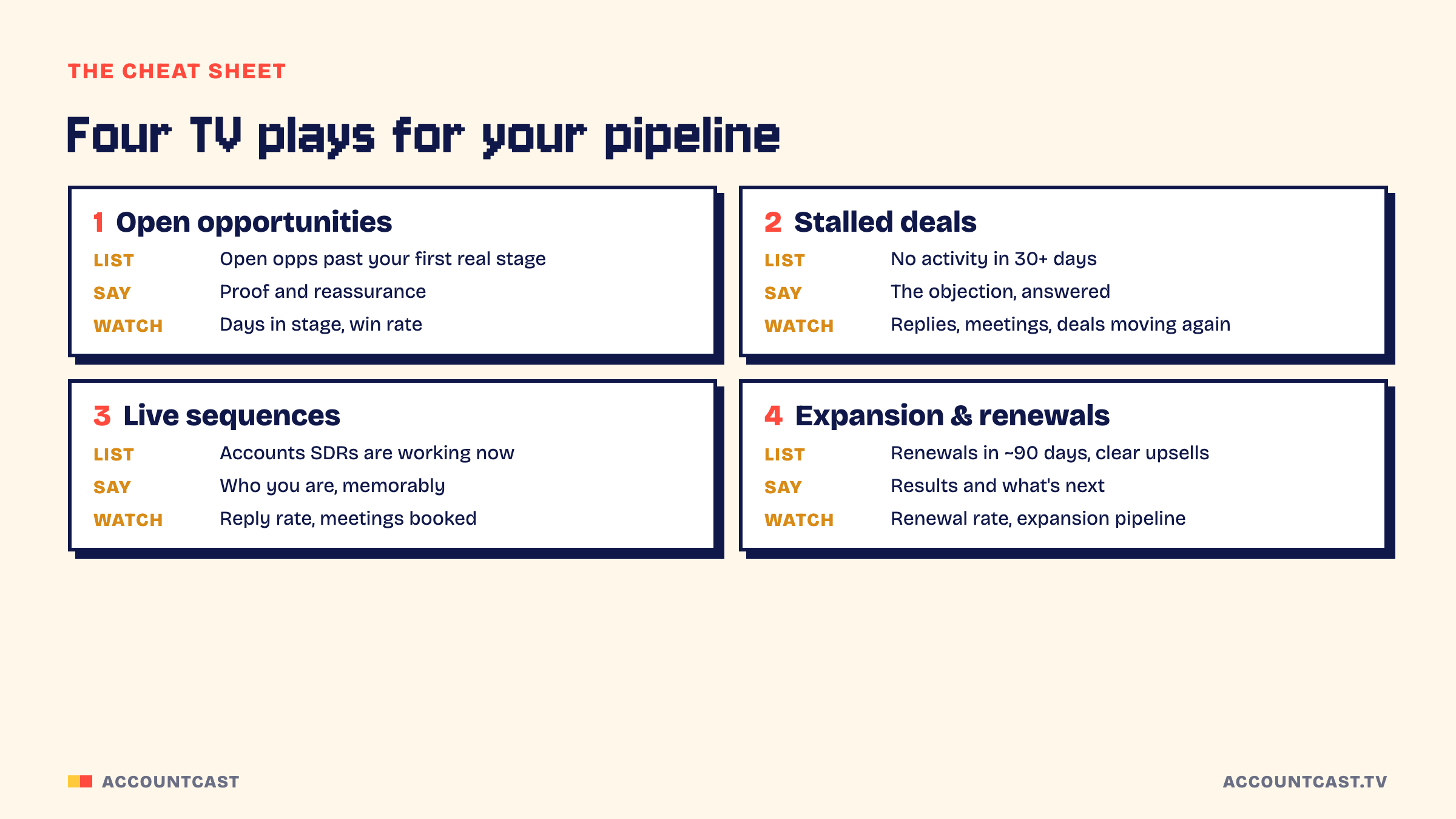
| Play | List | Message | Run | Watch |
|---|---|---|---|---|
| 1. Open opportunities | Open opps past your first real stage | Proof and reassurance | While the deal is open, light frequency | Days in stage, win rate |
| 2. Stalled deals | Opps with no activity for 30+ days | The objection, answered | Two- to four-week burst, plus one rep follow-up | Replies, meetings, deals that move |
| 3. Live sequences | Accounts in active SDR sequences | Who you are, memorably | From a few days before the sequence, refreshed weekly | Reply rate, meetings booked |
| 4. Expansion and renewals | Renewals in the next 90 days, plus clear upsells | Results and what's next | From before the renewal talk through the decision | Renewal rate, expansion pipeline |
What do you need to set it up?
You need four CRM fields, a list refresh every week or two, and your sales team in the loop. You don't need a big project for this.
1. The right CRM fields. Opportunity stage, last activity date, close date, and renewal date. Those build every list in this post.
2. A refresh rhythm. Refresh lists every week or two so you're not spending on accounts that already signed (or walked).
3. Sales in the loop. This matters most. Tell reps which accounts are seeing the ads and for how long, so they can open the next call with it.
What mistakes should you avoid?
The biggest mistakes are generic ads, testing too many things at once, judging TV on clicks, and keeping sales in the dark.
Don't run "learn more" ads at deals in motion. They already know you. Match the message to the stage.
Don't change five things at once. One clean test beats four messy ones.
Don't judge it on clicks. Nobody clicks on a TV. Use the CRM number you picked.
Don't hide it from sales. Worth saying twice.
Where should you start?
Start with stalled deals. Pull the list, write the one-line answer to the objection that keeps coming up, and run a two- to four-week burst with one fresh rep follow-up. Then compare how many deals move again against the stalled deals you left alone. If that number moves, add a second play.
Frequently asked questions
Can TV ads target specific companies in my sales pipeline?
Yes. Account-based TV targeting starts from a list of companies, such as accounts pulled from your CRM. It matches people at those companies to their households and shows your ad on streaming TV in those homes. You get a report of which accounts on your list were reached.
Which bottom-of-funnel TV play should a B2B team run first?
Stalled deals are a good first play. You already know these accounts, the list is easy to pull (open opportunities with no activity for 30 days or more), and the message is clear: answer the objection that stalled the deal. Run a two- to four-week burst, pair it with one fresh outreach from the rep, and watch replies, meetings, and deals that start moving again.
How do you measure whether TV ads helped close a deal?
Pick one CRM number before you launch, such as days in stage, win rate, reply rate, or renewal rate. Set aside similar accounts that don't see the ads, then compare the two groups after the flight. Don't judge TV ads on clicks, because people don't click on a TV.
What should a TV ad say to an account that already knows you?
Match the message to the deal stage. Open deals need proof and reassurance. Stalled deals need the common objection answered in one line. Accounts in a sales sequence need a simple, memorable introduction. Renewals need results and what's next. Avoid generic "learn more" spots for accounts already in your pipeline.
How often should B2B TV ads run during an open deal?
Keep frequency light and treat any number as a starting point to test. A few times a week per household is a reasonable place to begin for open opportunities. Stalled deals suit a two- to four-week burst. For sales sequences, start a few days before the first email and run through the end of the sequence.
Why use TV ads for renewals?
Renewals are often decided by people who weren't part of the original deal, such as a new VP who replaced your champion. TV ads reach those people at home before the renewal conversation. Start early, show results and what's next, and track renewal rate and expansion pipeline.