Blog · Part 1 of 5
LinkedIn TV Ads vs. Account-Based TV Ads: What's the Difference?
LinkedIn CTV and account-based connected TV both put your B2B ad on a streaming TV. They're built for different jobs. Here's how to pick, or use both.
Danny Stedman · · 10 min read
Short answer: LinkedIn TV ads are built for brand awareness: they reach types of professionals and report on delivery and demographics. Account-based TV ads start from your target account list and report back which of those companies were reached, by name. Use LinkedIn to build your name with a broad market, and account-based TV when you need to reach specific accounts sales is working.
Key takeaways
- LinkedIn TV ads (LinkedIn CTV) run as brand awareness campaigns with maximum-delivery bidding, according to LinkedIn's own help page.
- LinkedIn TV ads can target an uploaded company or contact list; in Kiin's 2025 to 2026 benchmark of 118 campaigns, 58% did.
- In that same benchmark, the median LinkedIn TV campaign reached 5.4% of its target list.
- Account-based TV ads report reach account by account, so you can line results up against your CRM.
- For many B2B teams, using both makes sense: LinkedIn TV for the market, account-based TV for named accounts.
If you run demand generation and you've brought up TV ads in a meeting, you've probably heard this from your CMO: "Can't we just do this on LinkedIn?"
It's a fair question. You already have a LinkedIn budget, a LinkedIn rep and a LinkedIn login. So let's answer it straight.
What is LinkedIn CTV?
LinkedIn CTV is LinkedIn's connected TV ad product: your video runs on streaming TV, aimed using LinkedIn's professional data.
Connected TV (CTV) means TV watched through the internet, on a smart TV or a streaming device, rather than through cable. CTV ads are the commercials that play during those shows.
LinkedIn launched CTV ads in April 2024. Your video runs through publishers like Roku, Samsung Ads and Paramount, with NBCUniversal available through a managed program. Since spring 2026, you can also buy LinkedIn's TV ads through Amazon's ad platform.
The big idea is LinkedIn's data. LinkedIn knows people's job titles, seniority, industries and employers, because people told it. So you can aim a TV ad at "VPs of IT at mid-size software companies" and LinkedIn matches those members to their households.
Can LinkedIn TV ads target my own account list?
Yes, LinkedIn TV ads can target an uploaded company list or contact list.
In Kiin's benchmark of 118 LinkedIn TV campaigns across 31 advertisers (September 2025 to September 2026), 58% of campaigns targeted an uploaded company or contact list.
The ads also get watched. Kiin's benchmark found a 98.7% completion rate for LinkedIn TV ads. It's TV, and most of these ads can't be skipped.
So if anyone tells you LinkedIn's TV product is a toy, they're wrong. It's a real product with real data behind it.
What are LinkedIn TV ads built for?
LinkedIn TV ads are built for brand awareness.
On LinkedIn's help page for connected TV, the campaign objective is brand awareness and the bidding is set to maximum delivery. When LinkedIn launched the product in 2024, its team positioned it as a way to build awareness over a long B2B buying cycle, not to acquire customers directly.
That shapes what you get back. LinkedIn's TV reporting covers delivery and professional demographics: how many people you reached, by title, seniority and industry. For deeper measurement, LinkedIn offers brand lift tests, conversion lift (whether people who saw the ad took an action more often), and reach reporting through iSpot, a TV measurement company. A brand lift test is a survey study that compares people who saw your ad with people who didn't, to see if awareness or opinion of your brand went up.
What I couldn't find anywhere in LinkedIn's help pages is a report that tells you which of your named accounts actually saw the ad.
That's not a flaw. It's a design choice. If your goal is "make more finance leaders in our category know who we are," demographic reporting and a brand lift study are the right tools. But if your goal is "get in front of these 400 companies sales is working," you need a different answer.
What are account-based TV ads?
Account-based TV ads (also called account-based CTV) are TV ads aimed only at the companies on your target account list, with reporting on which of those companies were reached.
They come from account-based marketing (ABM): the B2B practice of picking a specific list of companies to win and focusing marketing and sales on them. That list is called a target account list.
Here's how it typically works:
- You hand over your target account list. The same one your sales team already works.
- The platform finds the people at those accounts who match the roles you care about.
- Those people are matched to their homes. Their contact details are turned into private, scrambled codes (hashed emails) and matched to households, so raw names and email addresses aren't shared.
- Your ad runs on streaming TV in those homes.
- You get a report of which accounts were reached. By name. Account by account.
That last step is the difference. Instead of "40,000 IT decision makers reached," you get a list: these accounts on your list were reached, and these weren't.
Your list goes in, a report on your list comes out. Everything in the middle is about hitting the fish you aimed at and skipping the by-catch.
How much of my target list will a LinkedIn TV campaign reach?
In Kiin's benchmark of 31 advertisers (September 2025 to September 2026), the median LinkedIn TV campaign reached 5.4% of its target list, at a median frequency of 1.95 ads per person reached.
Numbers like that are why "how much of my list did we reach?" is the first question to ask any TV platform you hand a list to.
One caution for when you compare vendors. Kiin's 5.4% is reach: the share of a list a campaign actually reached. That's different from match rate: the share of a list that can be reached. Match rate is the ceiling, and reach is what a campaign's budget and length get you under it. Ask every vendor for both.
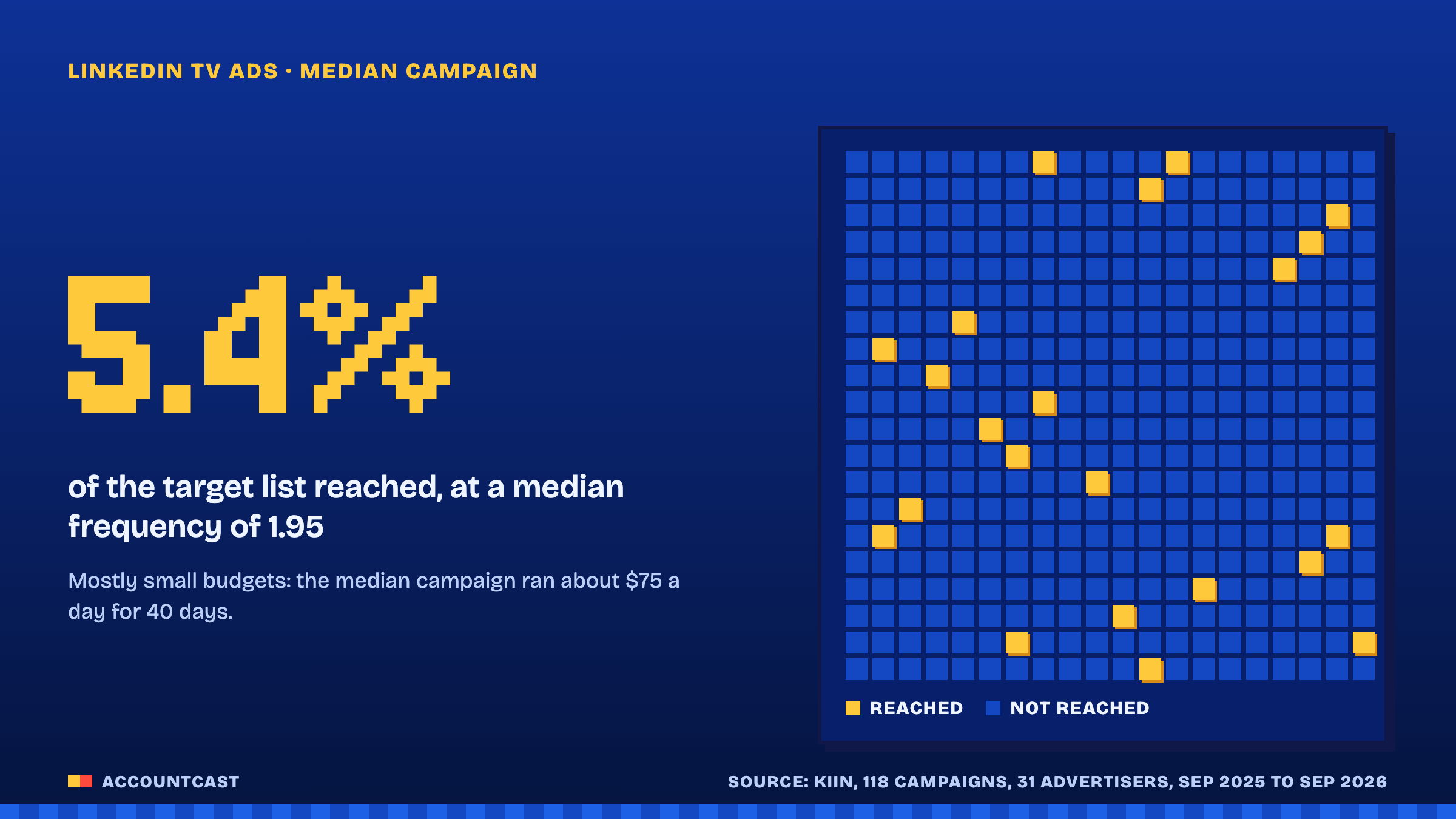
Before anyone screenshots that and calls it a gotcha, some context in LinkedIn's favor. These were mostly small campaigns. Kiin's median LinkedIn TV campaign ran on about $75 a day for 40 days, and median annual spend per advertiser account was $9,912. Small budgets reach small slices of a list.
Still, it tells you something. A platform built for awareness spreads impressions to deliver as many as it can. That's what "maximum delivery" means. It isn't trying to cover every account on your list, and LinkedIn's help pages don't describe an account-by-account report, so you may never know which 5% you got.
Kiin found one more thing. Across 26 advertiser accounts, there was no "halo": LinkedIn TV ads did not measurably lift LinkedIn feed campaigns running at the same time. Kiin also says post-view conversions are "evidence of lift," not leads you can count. That's a fair caution for any TV ad.
How is account-based TV different from LinkedIn TV ads?
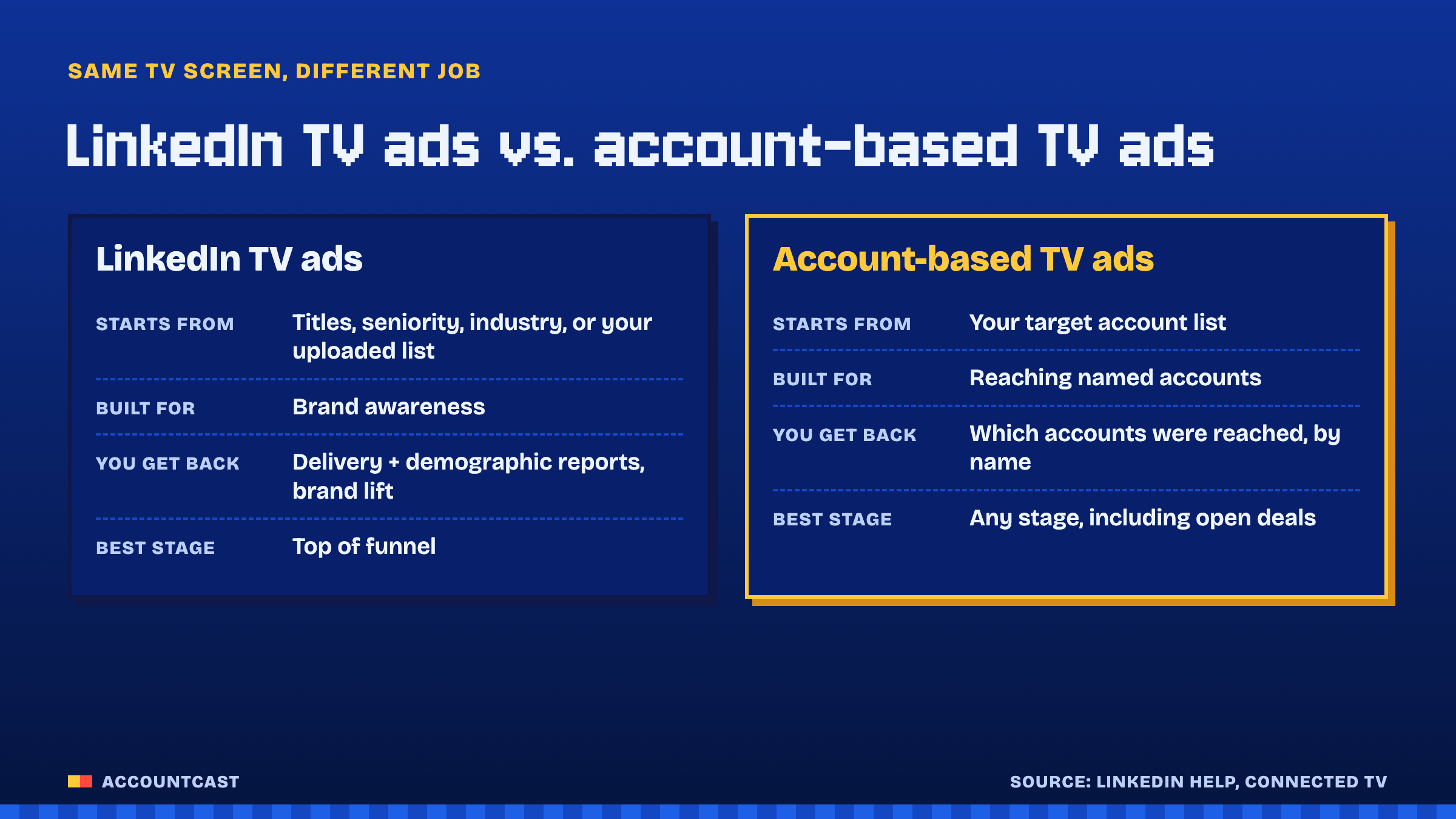
The main difference is the starting point and the report: LinkedIn starts from audiences and reports demographics, while account-based TV starts from your list and reports by account.
| LinkedIn TV ads | Account-based TV ads | |
|---|---|---|
| Starts from | LinkedIn audiences: titles, seniority, industry, or your uploaded list | Your target account list |
| Built for | Brand awareness | Reaching named accounts, including ones already in your pipeline |
| Bidding | Maximum delivery | Aimed at covering your accounts |
| What you get back | Delivery and demographic reporting, brand lift, iSpot reach | Which accounts were reached, by name |
| Best stage | Top of funnel | Any stage, including open deals |
| Where it runs | US and Canada per LinkedIn's help page, English audiences | Varies by platform; ask each vendor |
| Typical cost | Kiin median CPM: $25.76 | Varies by platform, list size and flight length |
CPM means cost per thousand impressions, the standard way TV and digital ads are priced.
Should I use LinkedIn TV ads or account-based TV ads?
Use LinkedIn TV ads if your goal is a type of person, and account-based TV ads if your goal is a list of companies.
Pick LinkedIn TV ads if:
- You want to build your name with a broad professional audience, like "HR leaders at companies with 500+ people."
- You don't have a defined target account list yet, or it's huge.
- Brand lift and demographic reach are the numbers your boss wants.
- You already run LinkedIn and want TV in the same dashboard.
Pick account-based TV ads if:
- You have a real target account list and a sales team working it.
- You need to answer "which of our accounts saw this?" with names.
- You want to use TV on deals already in motion, not just at the top of the funnel.
- You want the report to line up with your CRM, account by account.
Can I use LinkedIn TV ads and account-based TV ads together?
Yes, and for a lot of B2B teams that's the best answer: each one does its own job, in order.
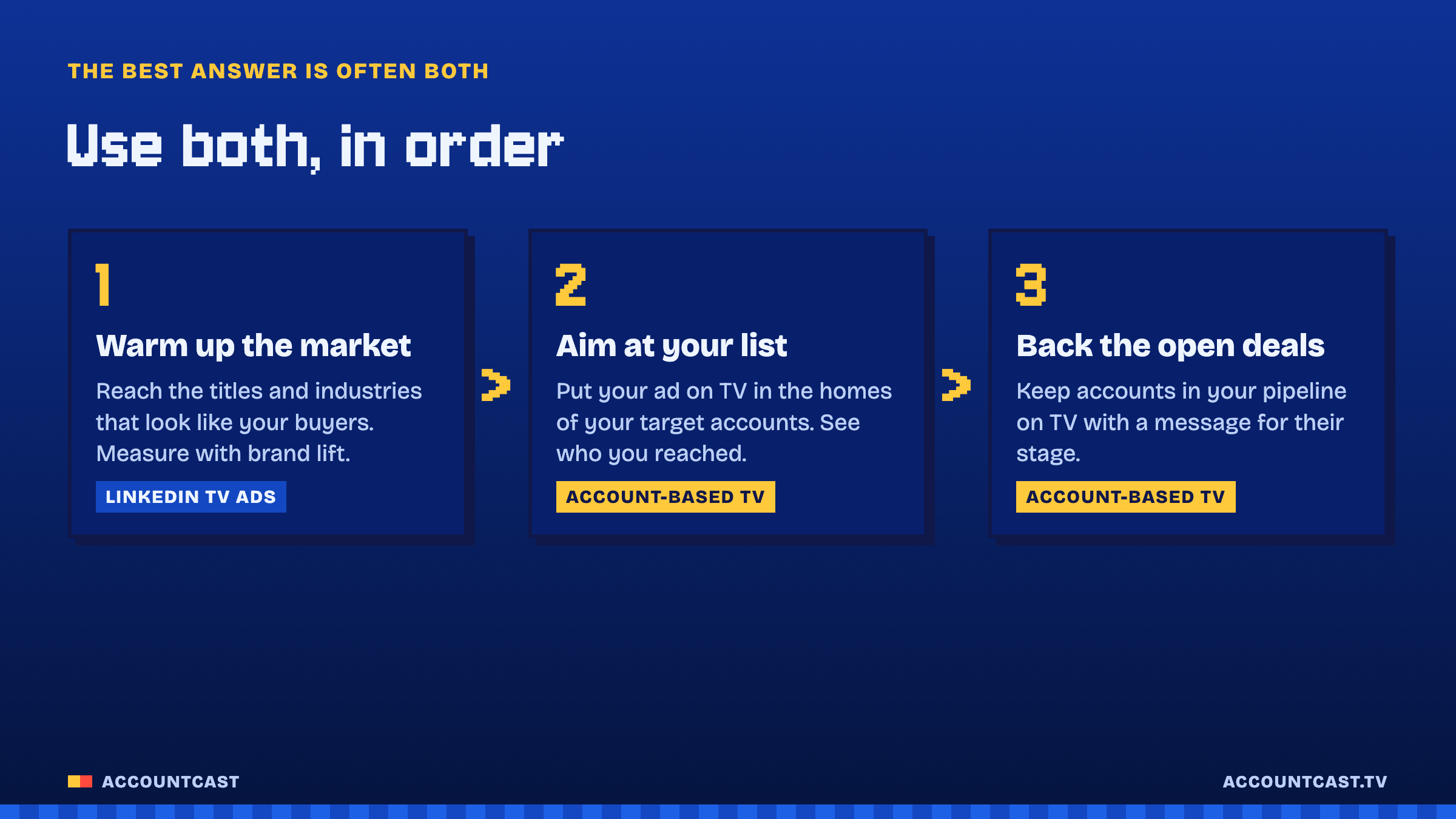
- Use LinkedIn TV to warm up the market. Reach the broad set of titles and industries that look like your buyers. Measure it with brand lift, which is what LinkedIn's tools are good at.
- Use account-based TV on your list. Once sales has a defined set of target accounts, put your ad on TV in those homes and get reach back account by account.
- Go deeper on the deals that matter. When accounts move into open opportunities, keep them on TV with a message for that stage, and line reach up against deal progress in your CRM.
LinkedIn is the wide net for the market. Account-based TV is the spear for the accounts you've already picked. You just have to know which job you're doing this quarter.
If your CMO asks "can't we just do this on LinkedIn?", now you've got the answer: "For awareness, yes. For our target accounts, we want to see who we actually reached."
Frequently asked questions
What is the difference between LinkedIn CTV and account-based CTV?
LinkedIn CTV is LinkedIn's connected TV ad product, built for brand awareness. It targets professionals by title, seniority, industry or an uploaded list, and reports on delivery and demographics. Account-based CTV starts from a B2B company's target account list and reports which of those specific companies were reached, account by account. LinkedIn suits building a brand with a broad market; account-based CTV suits reaching named accounts and deals in progress.
Can you upload a company list to LinkedIn connected TV ads?
Yes. LinkedIn lets advertisers target TV ads at an uploaded company list or contact list. In Kiin's benchmark of 118 LinkedIn TV campaigns across 31 advertisers, run between September 2025 and September 2026, 58% of campaigns used an uploaded list. The campaigns still run with a brand awareness objective and maximum-delivery bidding, and reporting covers delivery and demographics rather than which accounts were reached.
How much does LinkedIn CTV cost?
Kiin's 2025 to 2026 benchmark of 31 advertisers found a median CPM (cost per thousand impressions) of $25.76 for LinkedIn TV ads. The median campaign ran on about $75 a day for 40 days, and median annual spend per advertiser account was $9,912. Costs vary with audience size, targeting and budget, so treat these as one benchmark sample rather than a price list.
Does LinkedIn CTV report which accounts saw my ad?
LinkedIn's help page for connected TV lists delivery and professional demographic reporting, brand lift tests, conversion lift, and reach reporting through iSpot. It does not describe a report showing which named accounts on your list saw the ad. If account-by-account reach matters to you, ask your LinkedIn rep directly, or use an account-based TV platform that reports reach by company.
Is LinkedIn CTV good for B2B?
Yes, for brand awareness. LinkedIn CTV uses LinkedIn's professional data to put TV ads in front of chosen job titles, industries and seniority levels, and Kiin's benchmark found a 98.7% completion rate. It is less suited to reaching specific accounts in an active sales pipeline, because it's built for maximum delivery and reports on demographics rather than on named companies.
When should a B2B team use account-based TV ads instead of LinkedIn?
Use account-based TV ads when you have a defined target account list and a sales team working it, and you need to know which of those companies were reached. That includes deals already in motion, like open opportunities and stalled deals. Many B2B teams use LinkedIn TV to build awareness in the broader market and account-based TV for their named accounts.
Sources
- Kiin: LinkedIn CTV Ads 2026 benchmarks (118 campaigns, 31 advertiser accounts)
- LinkedIn Help: LinkedIn Connected TV
- LinkedIn Marketing Blog: Reach Engaged B2B Decision-Makers With LinkedIn CTV and Live Event Ads (April 2024)
- AdExchanger: LinkedIn Is All Business With CTV
- AI Digital: The Amazon-LinkedIn CTV Alliance
- LinkedIn Help: Upload company and contact targeting lists